

Welcome to Part 2 of the series, Lurker’s Guide to the Internet.
My goal with these posts is to help you evaluate the platforms you use and decide how to use them. There is no right or wrong platform to be on, and most aren’t inherently good or bad. What’s important is that your digital habits align with your goals and values.
Throughout the series, we’ll look at platforms through five lenses:
How do people find each other? (Connection)
How does content get surfaced? (Discovery)
Who sets the rules? (Governance)
Who pays for the platform? (Monetization)
Also check out this field guide to the platforms we’ll be referencing throughout the series. Think of it as a map of the terrain. It introduces the major platforms, explains why I included them, and highlights a few caveats to keep in mind as we go.
Let’s go! This time: Connection.
◾
Social media started with a promise to help people build stronger connections with each other. Twenty years later, whether that worked is up for debate.
Regardless of whether you feel more connected or more lonely online, the fact remains: Platforms bring people together. They do it in different ways, and foster different kinds of interactions.
Knowing how platforms are designed to connect you with others is critical to deciding where you want to spend time. And I believe that you can have a more fulfilling experience online when you are in spaces that meet your goals, preferences, and values.
◾
How platforms connect you with people
Generally speaking, your relationship with people online will fall in one of two buckets:
People you already know in real life and connect with online. This can include family members, close friends, colleagues, long lost classmates, or more.
People you don’t know, but share interests with. These are people who are looking at similar things, follow the same creators as you, or are making content that you are interested in.
Similarly, there are different types of interactions that you can have with people online:
Group conversations. These are participatory spaces where people contribute to a conversation. Groups can be as small as two people or as big as thousands or more.
One-way broadcast. This is where someone makes a post for the purpose of distributing it to a number of people. People may comment on the post, but the conversation is mostly centered around that person.
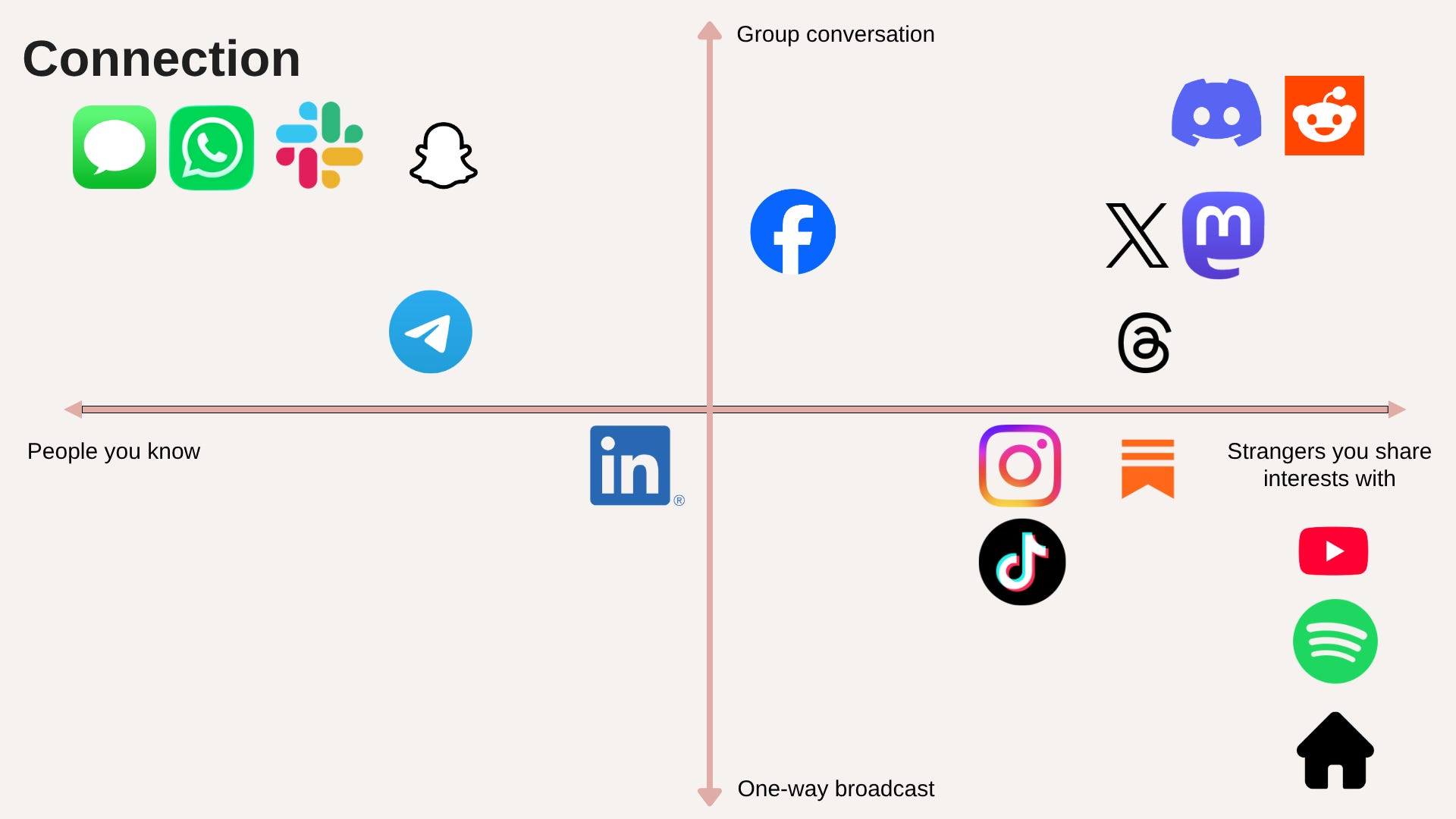
As we go from people you know to strangers you share interests with:
Chat groups — like on WhatsApp and Messages — are some of the highest trust spaces because of their privacy and exclusiveness. They are usually people you know in real life. Slack is more of a professional tool. As creators increasingly monetize their audiences, we’ll see a rise in chat communities being offered as paid, exclusive content. This is already happening on Slack and WhatsApp, and less on Messages which is only available to Apple users.
Snapchat is best known for its private messaging features, but it also has a public feed. It skews younger, and is heavily used by 13-24 year olds.
Telegram is a chat-first platform, which supports small groups to supergroups of up to 200,000 people. It also offers dedicated one-way broadcasting.
LinkedIn is a professional networking platform. You create a profile and connect with colleagues and professional acquaintances.
Facebook is a personal networking platform that has traditionally centered on connecting with people you know. However, Facebook Groups are heavily used for bringing people together with shared interests.
Instagram started as a personal sharing platform, similar to Facebook. But it has evolved towards interest-based connections, such as finding creators you may not know in real life but are making content you like.
X and Threads are more about topics of interest than personal sharing. Because they are based on short texts, they typically contribute to broader conversations or can generate back-and-forths among users. Substack is similar, but focused on long-form writing, which readers can comment on.
TikTok, YouTube, and Spotify are closer to a broadcast model, and people’s interactions tend to live in comments about a specific post, video, or podcast. YouTube, with its livestreaming feature, and X remain popular for people commenting during live events, such as sporting events or debates.
Mastodon facilitates posts, replies, and follows around shared interests, with a reply-and-boost culture akin to early Twitter days that fosters user interactions.
Discord and Reddit are both designed for public conversations around specific topics. Discord’s roots are in gaming and is more chat-based, whereas Reddit is organized like online forums.
Personal websites are typically one-way communications. If an interaction is desired with website visitors, it’s usually done via email or other platforms.
Note: In addition to public comments, direct messaging is also common on most platforms.
◾
As with anything that brings people together, platforms can host positive and negative interactions. Hopefully, this guide can help you spend more time with the good aspects — people you want to interact with, on topics you find fulfilling.
And remember: you always have the right to ignore someone, or to stop interacting with them. No explanation or fake politeness required. You always have the right to take your profile private, to block certain people, and to report bad behavior.
And you always have the right to leave a platform.
◾
Up next in the Lurker’s Guide: Discovery. How different platforms connect you with the content they think you’ll like. ◾