

When Facebook launched over twenty years ago, social media was new and simple. That was the platform we used because it felt like the only option.
Today, we communicate through a web of digital platforms. Information flows across messaging apps, social networks, newsletters, podcasts, discussion forums, and private communities. We no longer share one Internet; we’re each navigating our own version of it.
When I speak with experts about how they spend time online, many assume that all platforms work the same way. Most stick with what they know or whose brand they like.
But here’s the truth: each platform works differently, and most aren’t inherently good or bad.
Like choosing a family car or a pair of winter boots, you have a lot of choice in which platforms are right for you. Each is designed to work differently, and has its own tradeoffs. The best choice depends on what your goals are, who you want to connect with, and what kind of experience you want to have.
◾
That’s the idea behind this series, Lurker’s Guide to the Internet. It’s a framework for evaluating your options to help you lurk with intention.
Throughout the series, we’ll look at platforms through five lenses:
How is information communicated? (Format)
How do people find each other? (Connection)
How does content get surfaced? (Discovery)
Who sets the rules? (Governance)
Who pays for the platform? (Monetization)
Before we dive in, check out this field guide to the platforms we’ll be referencing throughout the series. Think of it as a map of the terrain. It introduces the major platforms, explains why I included them, and highlights a few caveats to keep in mind as we go.
Okay, let’s start. First up: format.
◾
If you've ever found yourself bouncing between Instagram Reels, Facebook posts, podcasts, and endless open tabs of articles, congratulations. You’re a human online.
But are you spending your time intentionally, based on your goals, preferences, and boundaries?
Different platforms are built for different types of content and ways to interact with people. Understanding what each does well is the first step to figuring out where you want to spend your time.
Written text
Benefits:
Free and easy to produce, so it’s accessible to any creator.
The easiest format for search engines to index and for AI systems to retrieve and analyze. That makes text-based content particularly influential in how information is discovered and reused.
Tradeoffs:
Requires literacy skills, which can vary widely.
Limited to whatever content is produced in your language. AI translation is reducing this barrier, but it remains a challenge for less common languages and dialects.
Images and graphics
Benefits:
Can simplify complexity in ways text can’t.
Can reduce language barriers.
Tradeoffs:
Requires design skills, which makes it less accessible to creators.
Risk of over-simplifying complexity.
Video
Benefits:
One of the dominant formats on today’s Internet.
Low technical barrier to entry for anyone with a phone or computer to film themselves.
Easiest format for showing personality and building familiarity with an audience.
Tradeoffs:
Making good videos takes time, skill, and practice.
Many people feel cautious about speaking on camera online.
Audio (podcasts)
Benefits:
Less demanding to consume than visual media and can be incorporated in your everyday routines.
Can build deeper intimacy with a creator without competing visual distractions.
Tradeoffs:
Limited to what’s available in your language.
New podcasts require marketing and can be hard to discover.
Once you’ve worked through format, there’s the question of short-form versus long-form.
Short-form content
For the purposes of this guide, I consider short-form content anything that can typically be consumed in under three minutes.
Benefits:
Useful for discovering new topics or creators, getting precise information that you need quickly, or simply for moments when your brain is just too tired to consume complex content.
A common entry point to more in-depth content on the topic or from the creator.
Tradeoffs:
Sacrifices either breadth or depth. So you often have to go back or find other formats for more information.
Long-form content
Benefits:
Offers more nuance and depth to a topic.
Often has a longer shelf life than short-form content, particularly when it answers evergreen questions.
Tradeoffs:
Requires more time and energy to consume, and may not be consumed to the end
Reaches a smaller audience of people who want to dive deep into the topic being discussed
◾
How the major platforms compare
Let’s start with text-first platforms. Remember that these maps focus on the primary way each platform is designed and used, and to check out the field guide to see which platforms I’m highlighting and why.
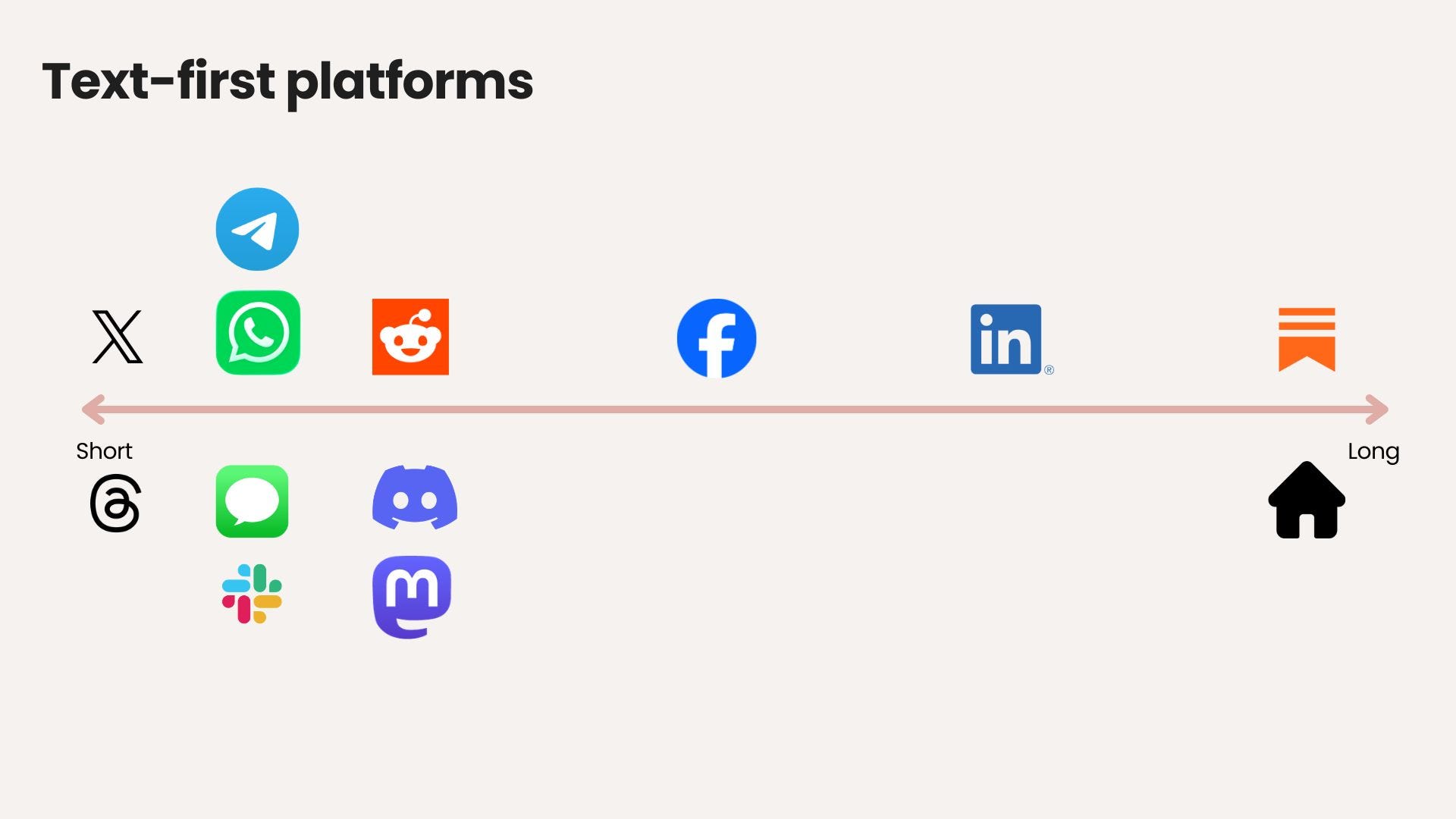
As we go short to long:
X and Threads are on the shortest end because they’re designed to restrict how many characters are allowed in any individual post. On X, you’re limited to 280 characters on the free version. And on Threads, the limit is 500 characters for regular posts.
Telegram, WhatsApp, Messages, and Slack are private messaging apps. They’re designed for shorter messages, but can be used for longer discussions. Messaging is a key part of the information ecosystem because communities often migrate from public platforms into private conversations. Creators also use these tools to offer exclusive content and build audience loyalty.
Reddit, Discord, and Mastodon are interest-based platforms, which are more open than private chat groups. Posts can vary in length, and long discussions may form among users.
Facebook was built on text posts. Length of posts can vary.
LinkedIn remains organized around written posts and articles, although video is increasingly prominent. It also offers a newsletter feature for longer writing.
Substack is designed for newsletters and longer writing, and your personal website is yours to make with as short or long text as you like.
Now let’s look at visual/audio-first platforms:
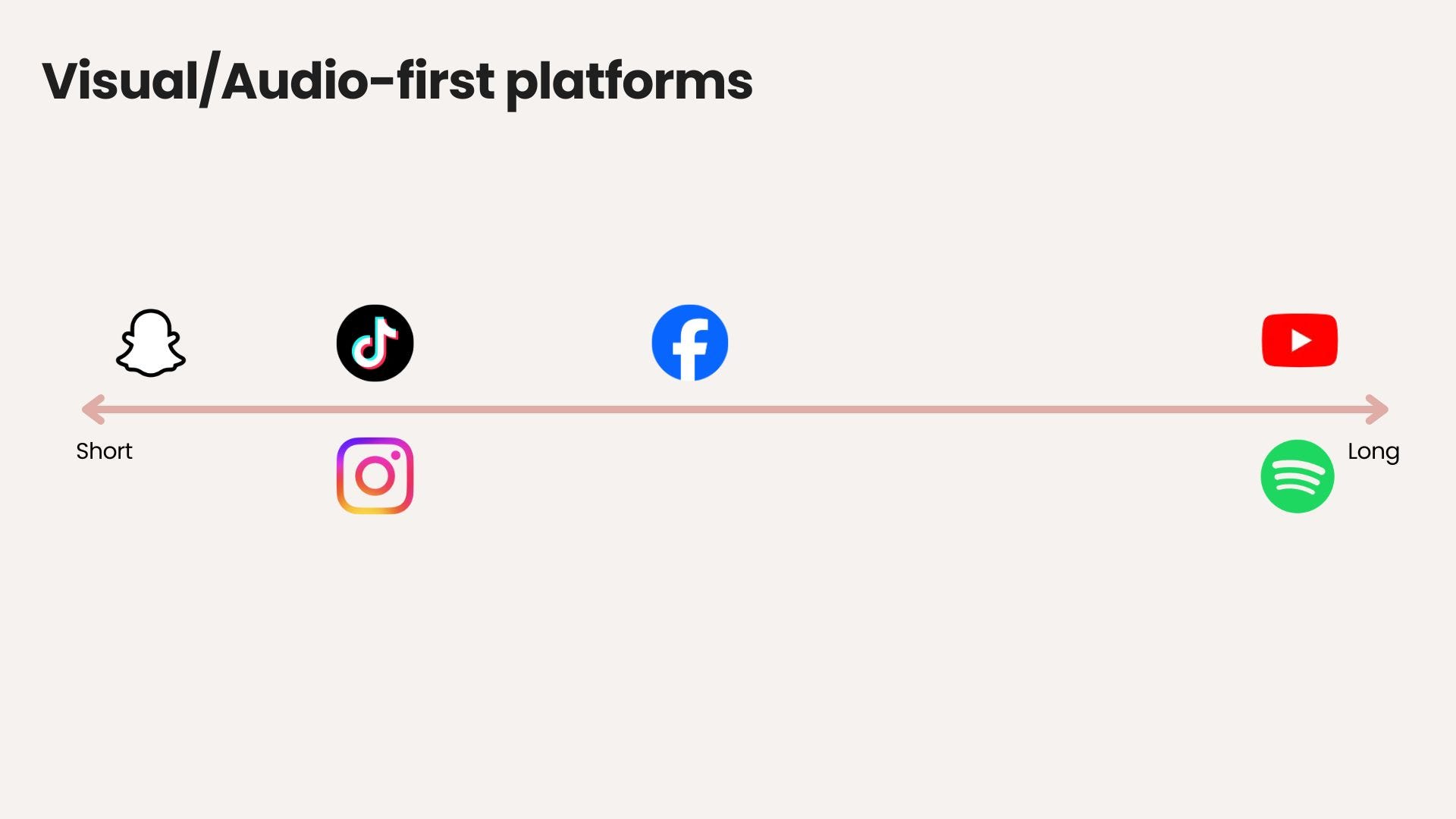
As we go short to long:
Snapchat is primarily a messaging app built around photos and short videos that disappear after they're viewed or after a set period of time.
Instagram is designed around images and short videos, while TikTok centers on short-form video. Because Instagram’s feed is mute by default, it’s important to have strong visuals that can get messages across even if there’s no sound. Whereas on TikTok, sound plays an important role and can even be a trend in itself. Multiple shorts can form a series to go more in-depth on topics.
Facebook started as a text-first platform, but is increasingly dominated by video. Videos can range from short-form to full press conferences and interviews.
YouTube is built around long-form video and can even host full-length films. It also distributes podcasts, as well as short videos through its feature YouTube Shorts.
Spotify is primarily a music streaming platform, but it has become the world's largest podcast distribution platform. Podcasts increasingly incorporate both video and audio-only formats. While there are short podcasts — like a headlines round-up, for example — it’s most commonly used for interviews and other long-form programming.
◾
When I was in school, we talked a lot about being audio or visual learners. It was common practice to acknowledge the different ways that people learn and absorb information.
That’s how I think about digital platforms. Once you understand their differences, choosing where to spend your time becomes less about what’s the “best” platform and much more about finding the right tool for you.
◾
Up next in the Lurker’s Guide: Connection. How different platforms connect you with other people. ◾