

🎧 Listen | 4:10 mins
Friends,
Over the last few weeks, I’ve fallen deep into the case of Lindsay Clancy, a former labor and delivery nurse who is currently on trial in Massachusetts for the deaths of her three young children. Central to the case is Lindsay’s postpartum mental health and the care she received in the months before her children died.
I first came across this tragic story in my TikTok feed. Of course, the more content I watched about it, the more TikTok gave me. Eventually, I started watching the trial livestreams on YouTube because I wanted to inform myself with primary information rather than relying on other people’s explanations and edits. I wanted to “do my own research,” as they say.
I’ve written before about how digital platforms make the public more participatory in other people’s tragedies. We also discussed on a recent episode of Did You See? the very complicated experience of having your personal story told by others. The Clancys aren’t the first family to have their real-life tragedy broadcast for others’ consumption, nor is this the first criminal trial to be livestreamed. But it does feel like another step towards the blending of our physical and digital worlds.
In fact, the digital discourse about the trial has become a story of its own. After a former social worker posted a TikTok responding to testimony she had watched online, Lindsay’s defense team tracked her down and sought to add her as a witness. And hundreds of people who are following the case gathered outside the courthouse to advocate for better care for mothers.
Of course, there are plenty of sensationalist takes and conspiracy theories in the mix. They’re distracting, sometimes grotesque, and often given disproportionate visibility by online commentators and media outlets alike. So let’s move on.
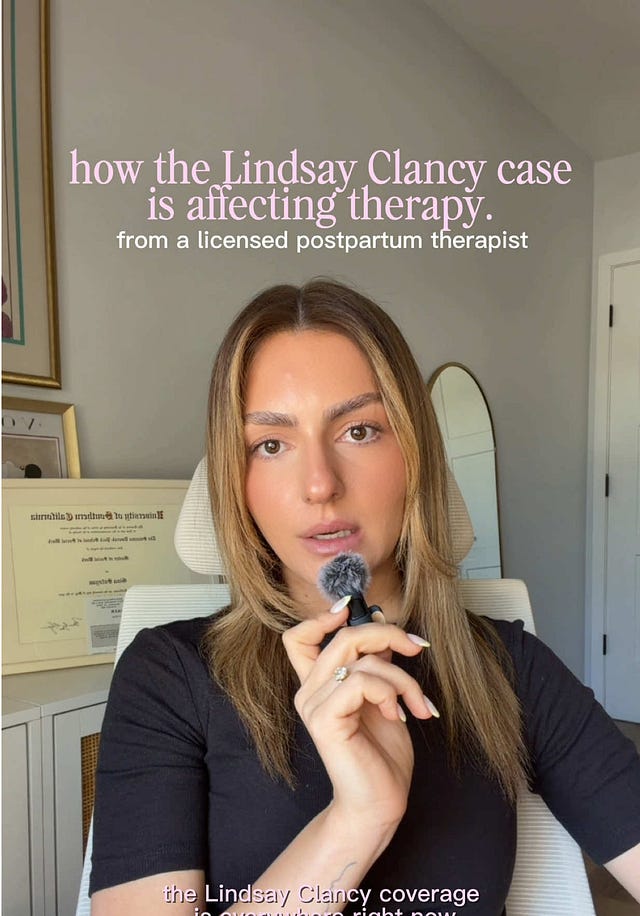
With a case this complex, you can go down any number of rabbit holes of your choice. Across TikTok, Instagram, Facebook, Reddit, and YouTube, professionals are contributing their expertise to help people interpret what they’re seeing. Attorneys are analyzing the legal strategies from both the defense and the prosecution. Psychiatrists and other mental health providers are adding context about clinical practice. Forensic scientists are explaining the work of investigating crime scenes and examining evidence. And mothers are sharing their own lived experiences of the postpartum period. The trial may be what’s sparked the conversation, but the insights being shared go much deeper and broader than this specific story.
 Tiktok failed to load.
Enable 3rd party cookies or use another browser
In that way, although the content I keep consuming about the case has made me feel incredibly sad over the last few weeks, it’s also been a fascinating study of the simultaneous amazingness and messiness of the modern information ecosystem.
This is the world we live in now: the boundaries among news, entertainment, and education are increasingly blurry; there is no shared, linear path for learning. We each encounter events through our own mix of sources, platforms, and perspectives.
But here’s the thing: having access to information isn’t the same thing as being able to understand it. As we’ve seen over the course of this trial, public understanding and opinion will increasingly depend on which voices show up to help people make sense of what they’re seeing.
Whatever role you want to play in that, just remember: when it starts to feel like too much, you have the right to take a break. I certainly will be.
◾
Below are other things I’ve been reading and thinking about this month.
And if you have a content piece to share or a favorite expert creator, send them my way by commenting or hitting reply. I’d love to include them in the next issue.
See you out there,

Did You See? with Jena and Michelle
🎙️ Did you see Toy Story 5?
What do our devices do to our imaginations? That’s what Toy Story 5 explores, the latest installment of a franchise that transformed animation and whose stories still feel relevant 30 years later. Plus: the World Cup goes full American, and offers new conversations on masculinity in sports.
🎙️ Did you see “The Bombing of Pan Am 103” on Netflix?
This is the episode I mentioned above, where Michelle and I discuss storytellers’ responsibilities when turning real tragedy into entertainment. Plus: Nara Smith pushes back on the “trad wife” label, and David Ellison asks the public to trust him with the news.
Available on Substack, Apple Podcasts, Spotify, or wherever you listen to podcasts.
News & Commentary
📝 When volume looks like verification
McGee Applied Research Center for Narrative Studies, Vanderbilt University | ~ 4 mins read
Crises are always chaotic information environments. Throw in explosive diarrhea, and you’ve really got a banger. Vanderbilt’s Kristy Roschke breaks down coverage about the recent cyclospora outbreak in the US, and shows how easily repetition can look like corroboration online. It’s a growing problem in an information ecosystem built on aggregation, where content amplifies and feeds on itself.
📝 Harvard is selling a $699 course taught by AI clones of its faculty
The New York Times | ~ 6 mins read
Harvard Business School is experimenting with AI clones of its professors to scale students’ access to their expertise and feedback. Students’ reactions have been mostly positive; most already use AI in their studies, and trust it more when it’s attached to a specific professor. It’s another reminder that human expertise and judgment are what’s most valued — even in an AI bot.
📝 That storytime TikTok is probably an ad
Link in Bio | ~ 6 mins read
I’ve long thought that institutions have a lot to learn from brands who have always had to study and invest in trust-building. But I can’t decide whether new strategies for disguising ads as organic content are genius or shady. They certainly highlight a need for advertising policies to catch up with how content works today. In the meantime, users will have to decide for themselves where they draw the line between content they trust and ads trying to sell them something.
📝 “You can’t just be showing Matcha-Pilates-Alo”
Vulture | ~ 9 mins read
It’s the influencer recession: blandness is out; unique perspective is in. Content that lacks personality feels like slop, people don’t want it, and lifestyle creators are feeling the pain. In response, they’re trying new strategies, including moving to long-form platforms like Substack. For experts hesitant about participating online, this is an opportunity: the Internet is looking for people with actual knowledge and a point of view.
🎙️ Free yourself from information overload
Life Kit | ~ 24 mins listen
Eye twitches, trouble settling down, interrupting yourself — these can all be signs of information overload. As we enter an AI-driven media landscape, our relationship with information will shift from searching for it to parsing through it, which is an even more demanding task for our human brains. This is a long game, so let’s be intentional with our time online and remember to take breaks.
Expert of the month
📚 Dr. Katie Carhart
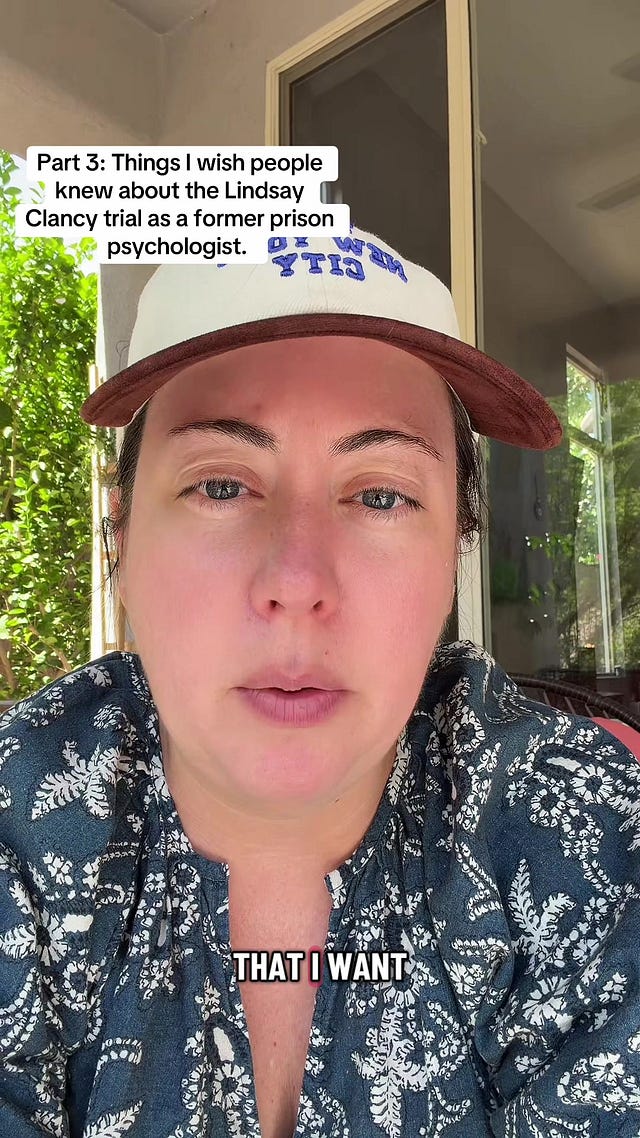
Dr. Carhart is one of the mental health providers I’ve encountered on TikTok during Lindsay Clancy’s trial. Her content offers general mental health education for adults. More recently, she’s been answering questions about postpartum mental health and access to care. Her account is a good example of what thoughtful expert participation can look like online: she ignores the thrash, chooses which questions to engage with, and responds to those showing genuine curiosity.
 Tiktok failed to load.
Enable 3rd party cookies or use another browser
It's amazing how much you cover in one substack. So much to dive into! And ending with Dolly:( Nice touch.