

Hi friends,
Two months into 2026, it’s already an unsettling year. One surreal moment for me has been watching American journalist Savannah Guthrie use Instagram to seek help after her mother’s disappearance.
Savannah has decades of experience in national TV news. She understands media — its reach, incentives, and power. So the Guthrie family’s choice to go public on Instagram was likely strategic. Still, seeing their posts while scrolling through my usual feed of cooking and dog videos felt intrusive. Like witnessing something deeply personal and painful in a space meant for casual viewing.
Bringing the public into a live investigation feels like a new inflection point in our relationship with tragedy. The true crime genre has long blurred the line between awareness and entertainment. But when events unfold in real time — when people use digital platforms not just to document but to ask for help — the boundary between witness and participant becomes less clear.
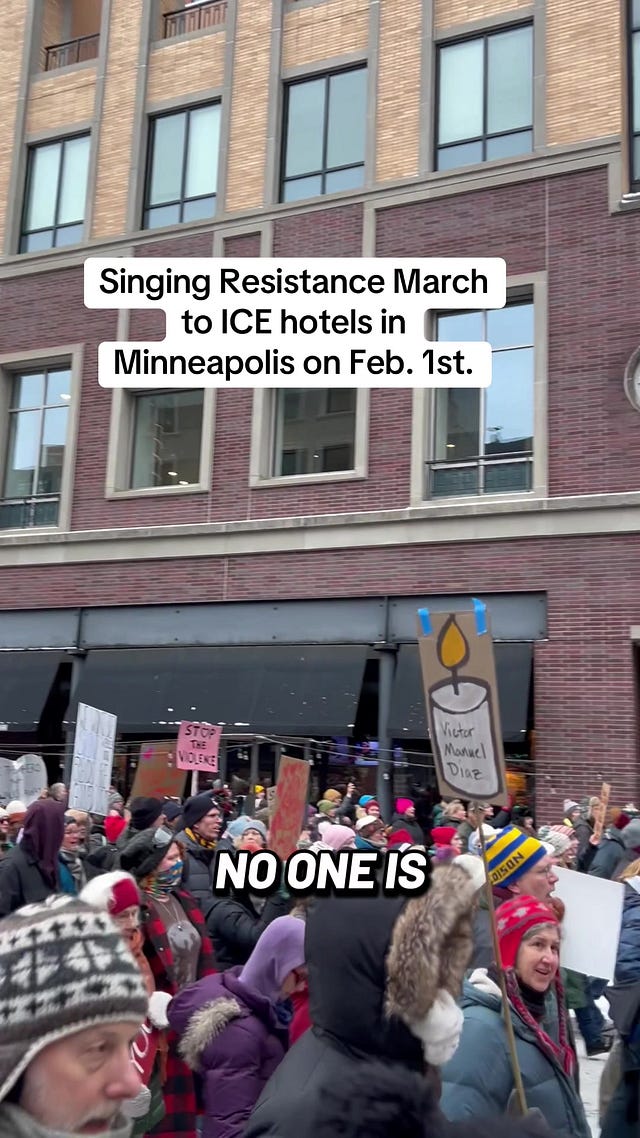
A similar dynamic emerged during the ICE enforcement surge in Minnesota this winter. Confrontations between federal agents and local citizens — including the killings of Renee Nicole Good, Alex Pretti, and others — led to widespread, on-the-ground footage. These videos did more than offer government accountability and counter-messaging. They invited public participation in protest, resilience, and collective grief.
 Tiktok failed to load.
Enable 3rd party cookies or use another browser
In our violent and unjust world, this pattern won’t fade anytime soon. Do you think we’ll become active, responsible witnesses — or numbed observers scrolling through?
Below are other things I’ve been reading and thinking about this month.
Do you have a content piece to share or a favorite expert creator to highlight? Send them my way by commenting or hitting reply. I’d love to include them in the next issue!
See you out there,

News & Commentary
🎧 Can we build a better social network?
Hard Fork | 40:48 listen
Longtime tech reporters Kevin Roose, Casey Newton, and PJ Vogt are building a social network in the fediverse, a decentralized web of platforms that can talk to each other. Imagine if your Instagram could follow someone on TikTok. They want to see if a new platform design can foster kinder interactions online.
It’s an interesting experiment. However, with less than 0.3% of social media users on the fediverse, I have to wonder: will civility come from product design or just a small, self-selected user base?
📝 The world is trying to log off US tech
Rest of World | ~6 min read
Rina Chandran discusses how global skepticism of American tech companies is driving demand for locally-made alternatives — from email to rideshare to social platforms.
This is a positive thing. Throughout my tech career, I’ve seen firsthand how scale comes at the expense of nuance. The communities that rely most on these technologies are often the first to get deprioritized under global commercial pressures.
From an information standpoint, this means that the ecosystem will get even more fragmented. It will be harder to manage, but that may also be a necessary correction.
📝 The Film Students Who Can No Longer Sit Through Films
The Atlantic | ~7 min read
University students enrolling in film courses are increasingly unable to sit through full-length movies. The ability to speed through slow scenes, replay missed moments, or half-watch while multitasking is reshaping both the discipline of film studies and the habits of young cinephiles.
For professors, the dilemma is familiar: should you adapt curricula to new norms, or maintain standards and risk lower enrollment? Every institution is navigating some version of this tradeoff right now.
📝 The role of doctors is changing forever
The New Yorker | ~12 min read
As authority decentralizes, doctors no longer command trust through credentials alone. Patients come with online research in hand, political movements challenge medical consensus, and AI is increasingly embedded in care delivery.
Dr. Dhruv Khullar argues this isn’t a distraction from real medicine, but a redefinition. Today, medical practice may extend beyond the exam room to sharing credible information online, engaging in advocacy, or building care-driven companies.
📝 How ChatGPT cites social media
Profound | ~9 min read
If you've ever wondered how LLMs use digital platforms as a source of truth, we now have some data. Reddit is the top source, accounting for roughly 2–3% of all ChatGPT citations. And individual content pieces are cited more often than creator profiles or organization pages. Notably, X is barely visible.
These findings underscore that AI systems are already treating user-generated content as knowledge infrastructure. So your engagement online isn’t just informing people; it’s also training the machines.
Shout-out to subscriber Carley Lake, who flagged this piece in her own newsletter. Carley writes about using AI intentionally to make us more human, not less — check it out!
📝 Podcasting at awards shows
Laineygossip | ~5 min read
It’s awards season, and this year we saw a new category at the Grammys and the Golden Globes: Best Podcast. It’s been fascinating to watch the medium evolve from scrappy creators in their basement to prestige properties led by mainstream personalities.
Sarah Marrs suggests that the real story is less celebratory. As writers and actors engage in ongoing labor negotiations, studios are now investing in podcasting for access to non-union content. And as podcasts become more professionalized, the independent creators who built the medium risk being pushed aside.
🎥 LISTERS: A Glimpse into Extreme Birdwatching
Owen Reiser | 1:59:09 watch
Released in August, this documentary follows brothers Quentin and Owen Reiser as they road trip across the US to explore the world of competitive birding. It’s sweet, funny, and visually stunning.
What’s remarkable is the Reisers’ distribution choice. Although they could have easily pursued the festival circuit, they released the film for free on YouTube. It’s another example of young creators bypassing legacy gatekeepers in favor of direct distribution.
Experts of the month
🍎 Joanna Johnson | @Unlearn16 (TikTok)
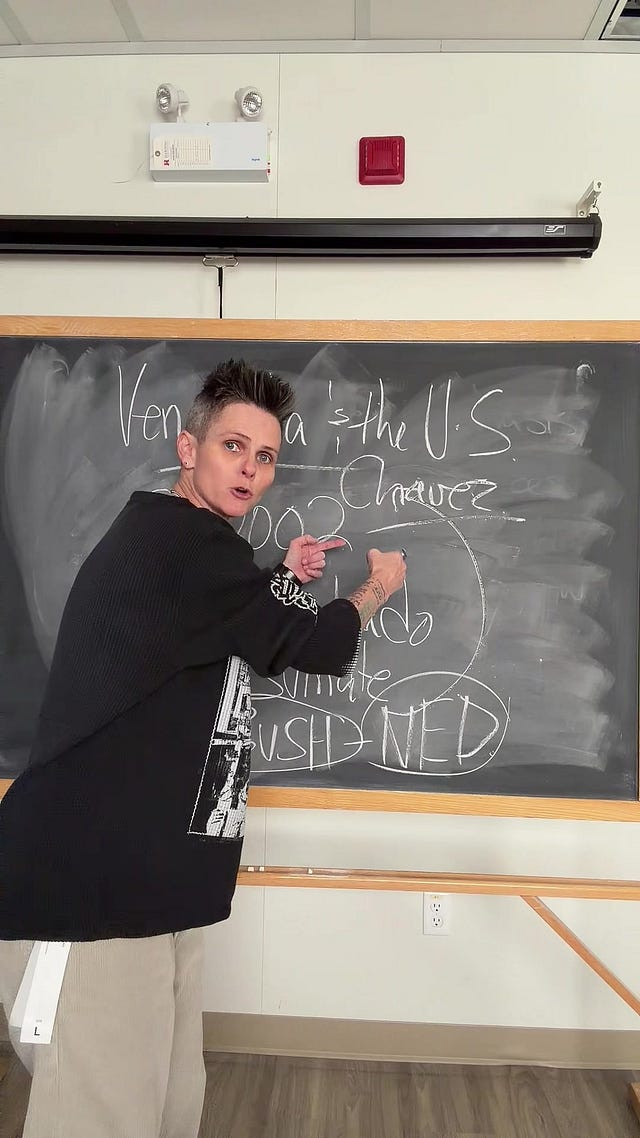
An Ontario-based educator, Joanna’s account was recommended to me many times this winter when she posted explainer videos on the history of US-Venezuela relations. Her content isn’t optimized for speed: most videos run five to ten minutes, with just her blackboard.
 Tiktok failed to load.
Enable 3rd party cookies or use another browser
Yet, she reaches millions of people.
Joanna shows us that depth isn’t a liability online, and there’s still demand for context. When knowledge is shared clearly and grounded in real teaching, audiences respond.
📚 Jiwon Yoon, PhD | Understanding Korea, One Story at a Time (Substack)
Jiwon’s essay for Media Education Lab on thinking critically about Korean content hit close to home for me. As an Asian-American, I’ve spent most of my life and career in predominantly White spaces. Her writing named something I have felt but never fully articulated about the recent rise of East Asian culture in the West.
When representation is unbalanced, it harms everyone — the underrepresented and the dominant culture. As Jiwon asks: what happens to your resilience and curiosity when the world arrives pre-translated for you?
🩺 Dr. Lara Zibners | Lara’s Substack
In her essay, Distrust is the Default, Lara reflects on her experience as a physician within a medical establishment increasingly viewed with suspicion. But trust doesn’t vanish; it shifts towards other (often less-qualified) voices. That complicates care for providers already navigating imperfect systems to do their jobs.
What struck me most was Lara’s humanity. Behind abstract discussions about institutions and credibility are people who have spent years training to help others. It’s a good reminder that today’s shifts in trust aren’t just an institutional problem. They’re a human one.
Happy place
This is a personal one for me. I spent my formative years as a university student in small-town Minnesota. Thank you to Brandi Carlile for supporting the brave people there, for celebrating the Singing Resistance Twin Cities, and for bringing comfort and community together online.
Thank you for this incredibly thoughtful curation, Jena. I especially appreciated your opening reflections on our changing relationship with tragedy and the blurring lines between witness and participant. It’s a vital conversation for our time.
I am also deeply grateful for your kind words about my essay. As an educator and researcher, seeing how my work resonates with your own lived experience as an Asian-American means the world to me.
Looking forward to more of your brilliant insights this year ❤️
I love this concept. I'd like to participate in the next installment of the next issue! So many good points highlighted in this piece.