

Are you a lurker? Someone who scrolls through the feed, watching, reading — but never posting?
If so, you’re not alone.
For over 20 years, the 90-9-1 rule (also called the 1% rule) has been used to describe how people participate in online communities. Of course, the proportions vary – an open platform like Instagram is different from a niche subreddit or a private Slack channel. But generally, the pattern holds.
Here’s how it works:
90% of people consume content only. Simply scrolling, watching, and reading.
9% of people engage in some ways. Such as commenting, liking, or sharing posts.
Only 1% actually post or create new content.
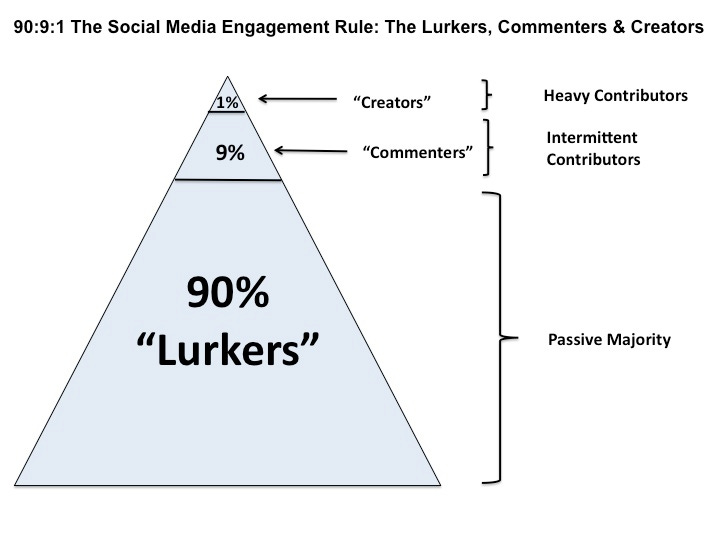
When people talk about the quality of information online (or lack thereof), most focus on the 1%. That makes sense. A tiny number of people are shaping discourse in the spaces people now use as their primary source of information. In that regard, it’s not all too different from legacy media; from newspapers to the movies, a select group of people make content for the general public to consume.
But in the digital world, there’s no such thing as a passive audience. The 99% play an active role too, and it’s just as important in shaping the information ecosystem.
Here are five ways you’re contributing online, even if you never post:
1. You watch a video – even briefly.
You don’t have to watch a video to its end for a platform to count it as viewed. When I worked at Meta, that threshold was three seconds.
It doesn’t matter if the video is actually 10 minutes long. It doesn’t matter if you stayed on it because you wanted to give it a chance, or got distracted by something else.
Views matter because in a world where 90% of people never engage, they’re a foundational signal that a piece of content is ‘high quality.’ And ‘high quality’ content gets shown to more people.
2. You rewatch a video.
You know how a replay button shows up when videos end? Or on TikTok, videos automatically loop and restart?
Every time a video gets played again, it counts as another view.
Some creators will take advantage of this. For example, they’ll make a short video with long captions. That keeps the video playing (and re-playing) while you’re reading. Each loop counts as a new view, and signals quality.
3. You save something, or you share it.
These are two different actions, but I’m putting them together because they both indicate that a piece of content is useful.
That said, they’re not equal. Sharing content is a higher-value action because it means you are putting something out there for others. Saving posts, on the other hand, suggests that you want to reference it later for yourself.
Again, it doesn’t matter why you save or share a piece of content. You might save a post with misinformation for research or share it with colleagues to analyze what people are saying about your field.
But the platform cannot distinguish between endorsement and examination. It only sees actions that say the content is useful and worth spreading.
4. You comment.
Like saving and sharing, people comment for different reasons. It can be anything from light encouragement – Congrats on the new job! – to deeper thoughts and discussion. You might also comment on a post because you believe it’s misleading and want to correct it.
I spent time at Meta studying how much it matters to make corrections in comments. What I learned was that the simple act of commenting – regardless of what the comment says – is enough to encourage wider distribution. That means more people will see the original post (but whether they’ll see your correction is less certain).
Also, commenting risks sparking further conversation – and each subsequent comment gives more signal that the original post should be spread further.
5. You follow or subscribe.
Following or subscribing to a creator tells a platform and its users that this is a voice worth being heard. That helps to make their content more visible to other people who need it — either through platform recommendations, or through your network discovering them through you.
Beyond that, following a creator tells them that their voice matters. Remember: creators are people too, and it’s not easy to put yourself out there. That’s why only 1% of people do it!
Following creators you like increases the chances that they’ll keep doing it, and keep making the kind of content you want to see.
◾
It’s ok if you don’t want to make content. Most people don’t. But the way you lurk matters.
I know it doesn’t feel like much in the moment. But together, our small actions play a big role in shaping who and what gets elevated. Not just for the algorithms, but for the people using these metrics to decide what kind of content they should make.
You may never post. But if you’re online, you’re contributing to the ecosystem. ◾