

Last week, YouTube argued in court that it is not social media. It’s a small part of what is otherwise a complex legal and ethical case. But it sparked headlines because it seemed absurd.
… I actually agree.
A core problem in the ‘social media’ debate is that we lack a clear definition of what the term even means anymore. That’s not because the platforms are new – Facebook is 22 years old, and YouTube is 21. In tech terms, they’re dinosaurs. What’s changed is how people use them.
It may not be immediately obvious to many of us – especially Gen Xers and millennials (myself included) who came of age alongside these platforms. They still look the same. And in many ways, so do our habits (if we’re even still on them). For many people, ‘social media’ has become a loaded term that sparks strong (often negative) emotions. That’s understandable.

But the original social media guinea pigs are today’s regulators, judges, journalists, experts, educators, and parents deciding how these platforms should be governed and used in daily life. So let’s be honest with ourselves: are we making those decisions based on our personal memories and emotions, or on what these systems actually are today?
◾
I was a junior in college when Facebook arrived on our campus. Tom was my first friend on MySpace. Back then, these platforms were marketed as tools for connection. For me, they revolutionized my ability to snoop on my crushes and frenemies.
By co-opting the term ‘friend,’ Facebook implied deeper interpersonal relationships than what often existed. It worked. The validation of receiving a friend request – wow, Alex from Econ wants to be my friend?! – was real.
So collectively, a whole generation internalized a definition of social media as a digital extension of ourselves.
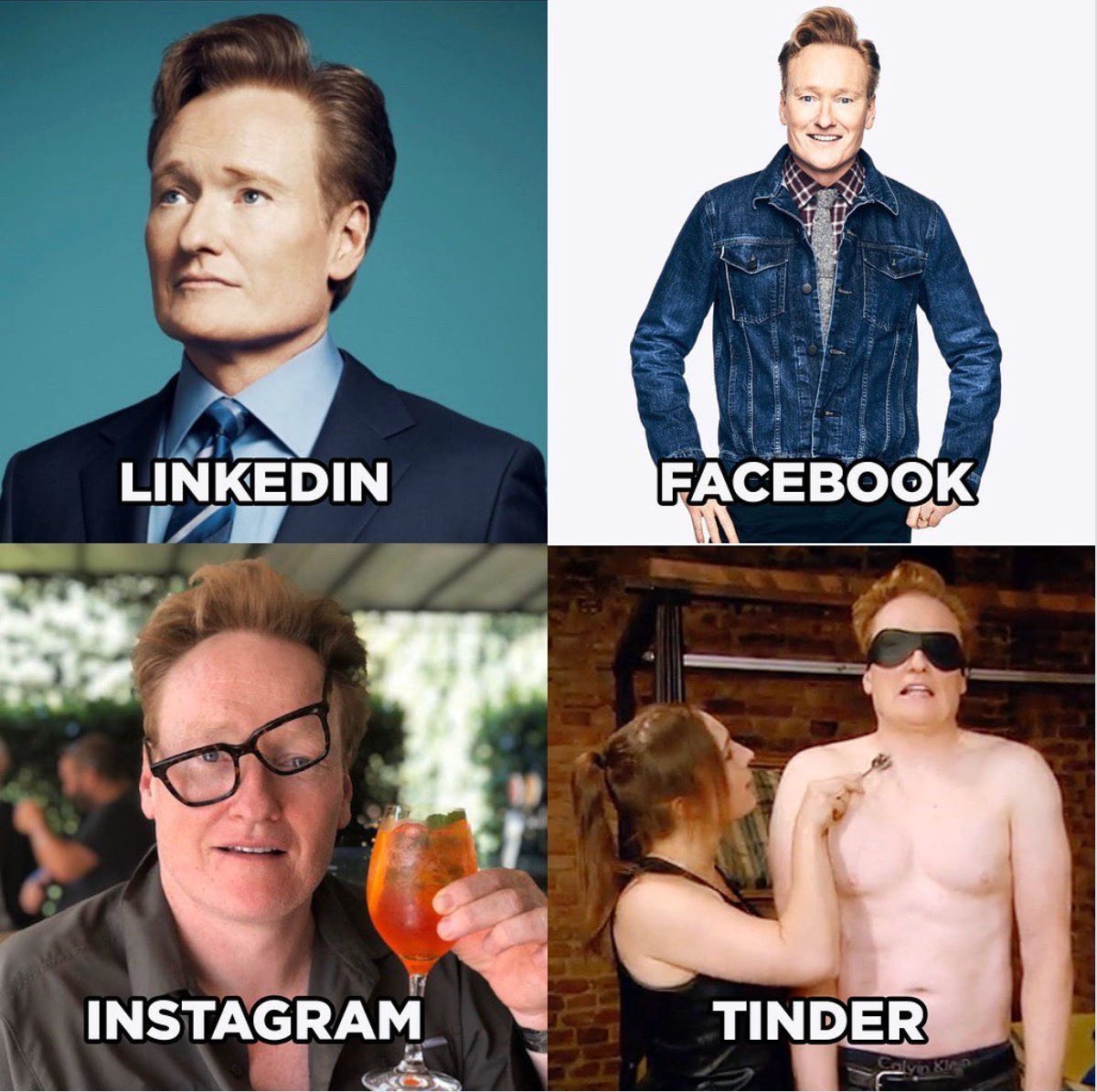
That’s how we used it – and in many ways, how we still do. Wedding announcements on Facebook. Pets and good hair days on Instagram. Work promotions on LinkedIn. Our feeds became curated reflections of ourselves – the versions we felt comfortable immortalizing, even as it edged towards the performative.
But over the last two decades, the landscape has shifted. We all grew up (or at least, we grew older). The experimental generation became the incumbents.
In some ways, we may be well-suited to shape the future of social media. After all, we’re the last generation to grow up before the Internet and the first ones to come of age with it. But that may also be our blind spot, because many of us are still anchored to social media’s original form.
You can see this in the rising nostalgia for the early Internet. In The New Yorker, Kyle Chayka longed for the days of mundane posting – breakfast photos and everyday moments. And the team at Hard Fork is building a ‘better’ social network modeled on the openness of the ‘90s and early-naughts.
I get the appeal.
But nostalgia generally makes me wary, because it often masks a desire for control. There were no simpler times – only different forms of gatekeeping.
Wishing for social media to return to its original form assumes that everyone experienced that era the same way (we didn’t). More importantly, it overlooks what these platforms have become for most people: primary infrastructure for research, learning, and decision-making.
◾
Social platforms have now surpassed traditional search engines as the primary place where people look for information. TikTok – often dismissed by older generations – is a core search tool for younger people. And across age demographics, over 80% of Americans report doing their own research online when making major life decisions.
These behaviors aren’t about social connection. They’re about seeking information.
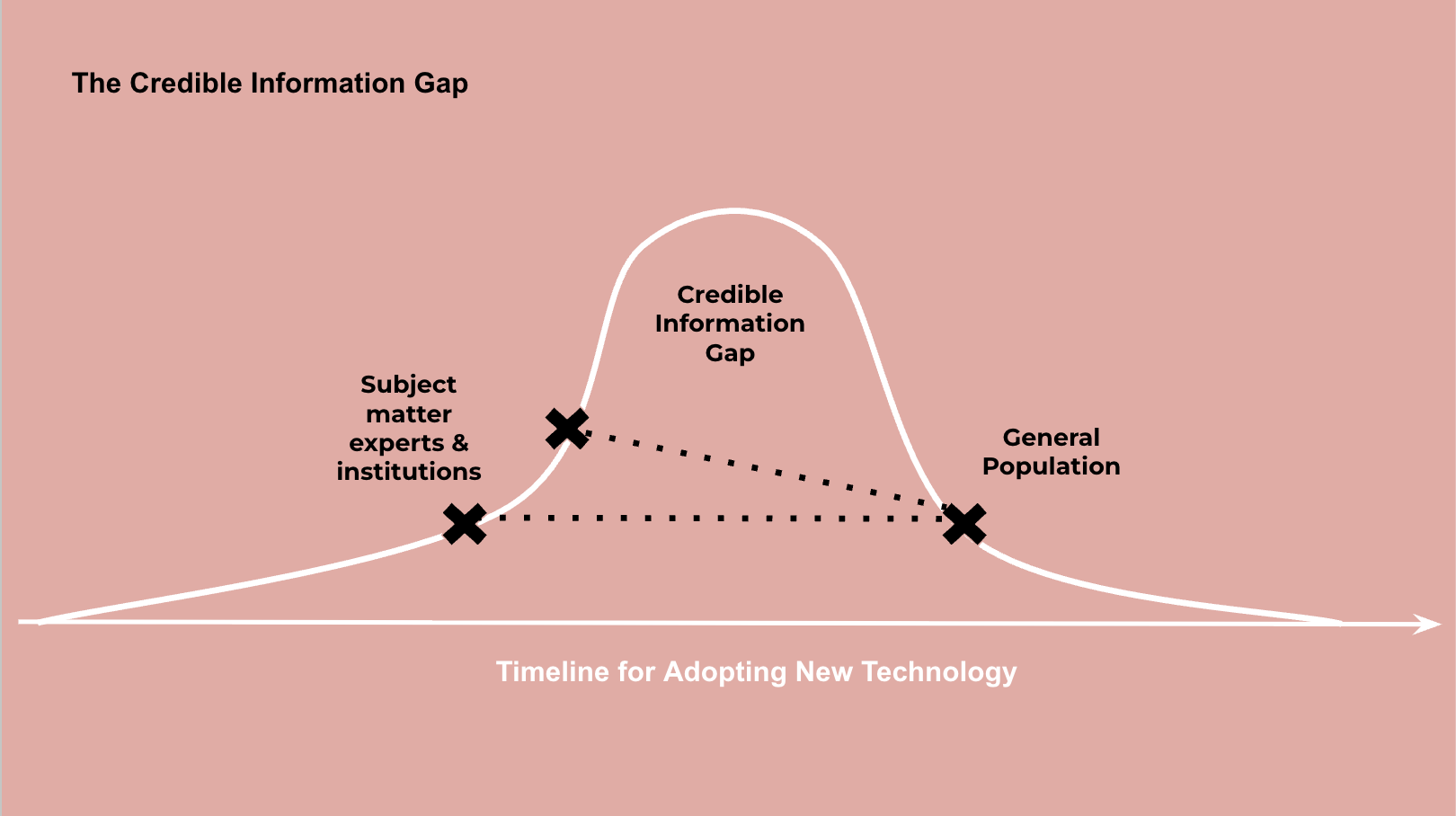
Yet, while these platforms serve as vital knowledge sources, credible voices often remain passive within them.
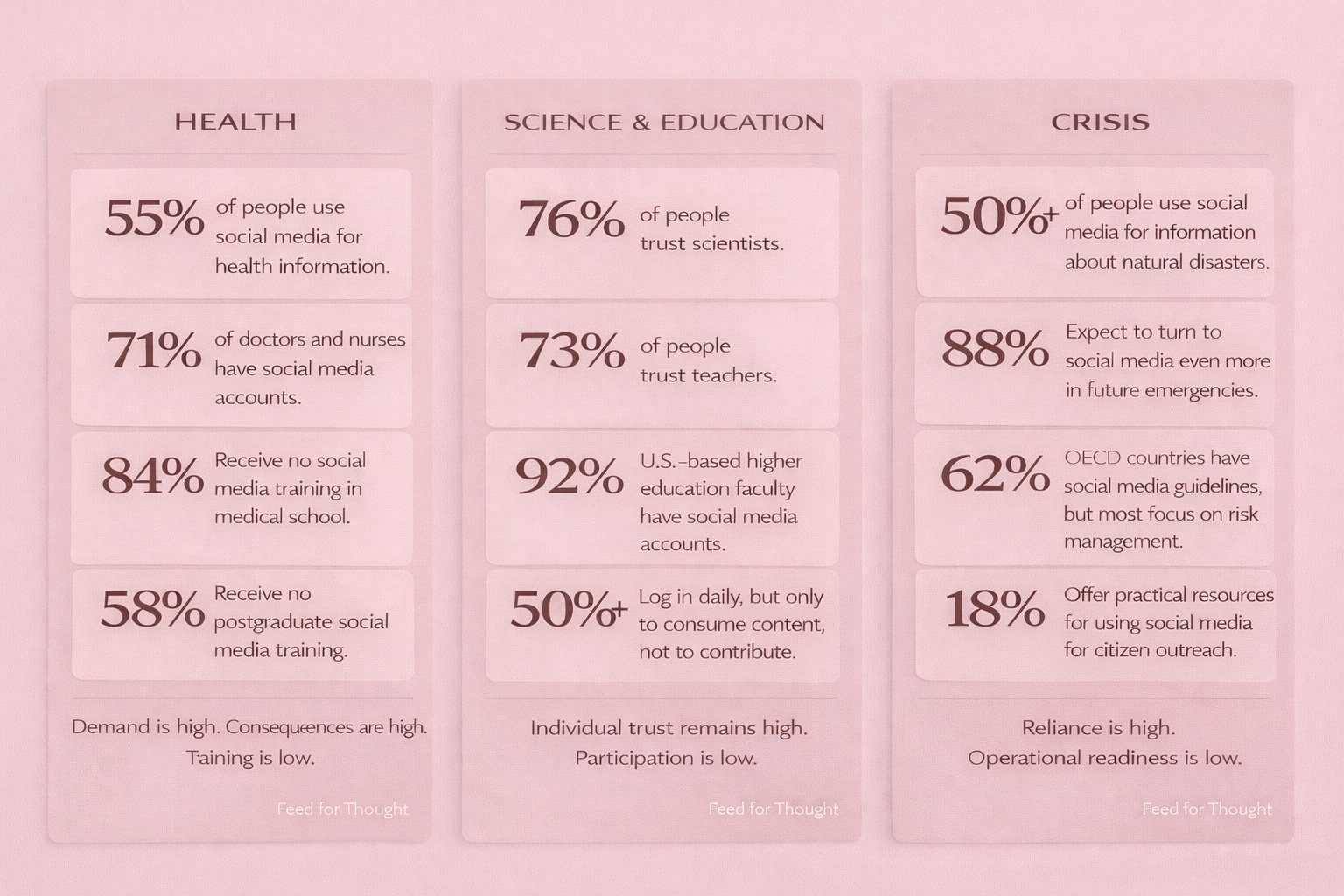
Across sectors, the same pattern persists.
Most people use social media to search, learn, and make decisions. Even as public trust erodes in institutions, it holds strong for individual experts.
Most experts have social media accounts. But they often lack training and support to use them for knowledge sharing.
This mismatch leaves a void — and in today’s world, voids don’t stay empty for long. Less credible voices will step in, disrupting public knowledge and reshaping standards for trust.
◾
I’m not especially interested in debating whether it’s good or bad that people use social media to find information. It’s simply the way it is.
That reality won’t change because we want it to, or because we personally quit the apps. And it won’t be solved by regulation or litigation alone. Content moderation and technical infrastructure matter, but they cannot compensate for the absence of high-quality content from credible sources of knowledge.
That’s why I see platforms like YouTube, TikTok, and Instagram less as ‘social media.’ They’re more like peer-based media — individuals publishing directly to other individuals.
And as AI becomes more common, their impact will compound. Large language models are increasingly drawing from social platforms as sources of truth. That means the quality (and gaps) of digital content won’t just shape what people see, but what machines learn.
Accepting the importance of peer-based media is not to diminish the value of editorial judgment or peer review. It simply recognizes that the future of public knowledge depends as much on accessibility as on credentials.
You don’t have to like this shift. I’d never ask anyone to like it.
But it’s here, and the future depends on who shows up to shape it. ◾
This is such an interesting take - i was particularly struck by your point about 71% of doctors and nurses having social media accounts but 16% receiving social media training at medical school. I hadn't thought about this but you're totally right - it's a missed opportunity. Plus, in my experience training focuses on the risks associated with social media (mainly to put you off using it) and not on potential ways medics can use it to benefit people. Do Universities need to update their curriculum to include social media and tech? How would they keep their teaching abreast of the ever-evolving landscape?
Good read - adding that social media hacks our brain reward center. Just like tobacco companies pirated our food supply and replaced it with highly processed foods that also hacked and hooked our brains. Which created chronic illness that now pharma can fix with expensive injections. To the tune of billions in profit. I predict there will be some capitalist, expensive, institutionalized fix to solve the social media addiction problem.