

“Like you, I imagine a world where actual facts, or at least best thinking, gets equal footing on social media alongside the quacks and the charlatans.”
This note came to me recently from a physician in California, who makes health content on Instagram. I love his framing: the issue isn’t about forcing trust. It’s about making expert knowledge competitive in the spaces where people now seek health information.
But what is it that makes “the quacks and the charlatans” so compelling?
This is the question we must address if we truly want to give evidence-based health information a chance online. Providing it is one challenge. Making it impactful is another.
If you feel bleak thinking about this, I get it. We live in a world where institutions — from universities to government to media — are losing public trust across the board.
But when it comes to medical expertise, the data tells a more complicated story.
◾
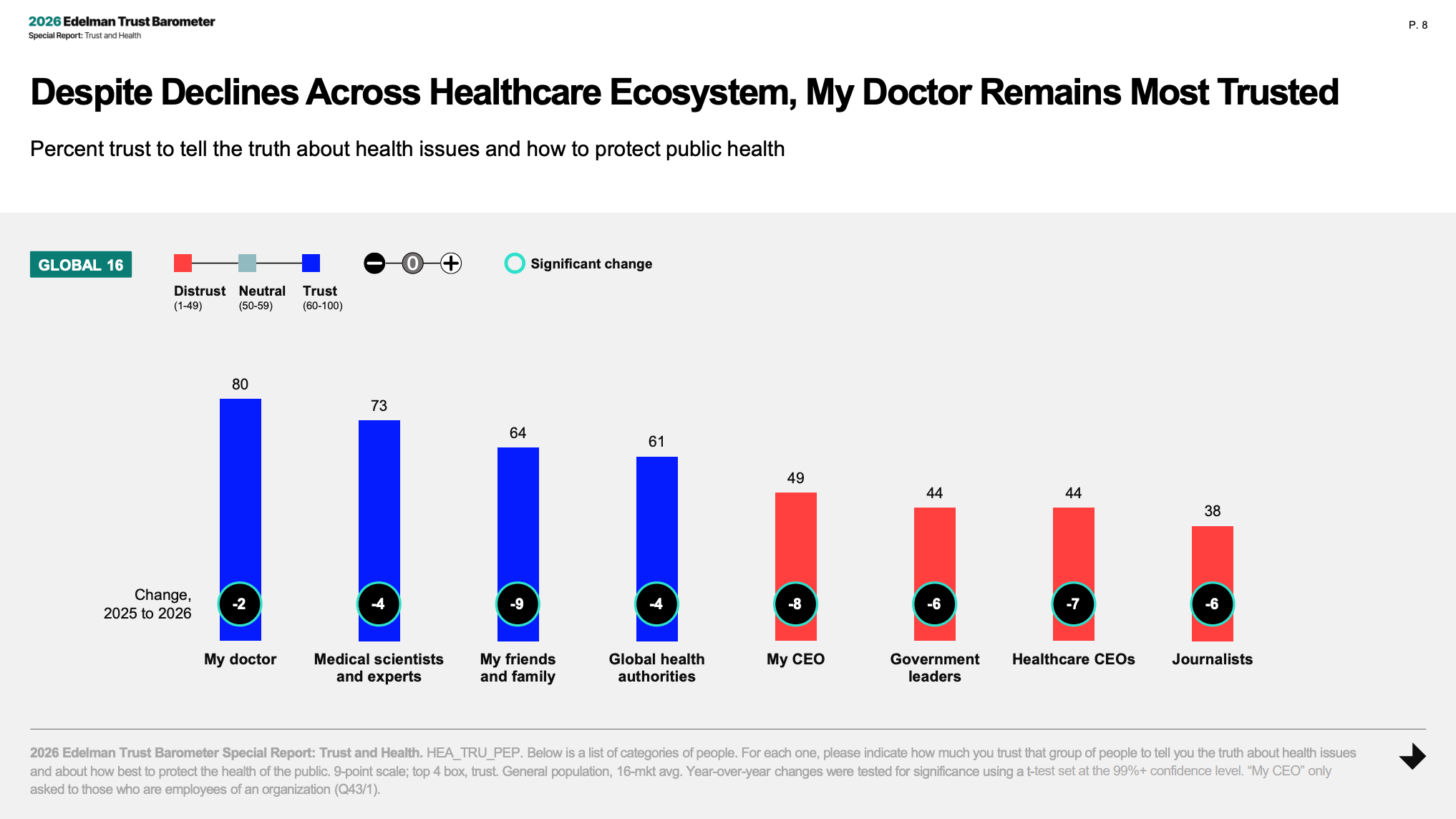
Research from the Edelman Trust Institute concurs that trust in health media has dropped. And yet, doctors and medical scientists remain the most trusted voices on health matters.
Globally, Edelman found that 80% of people trust their own doctor to tell the truth about health issues, while 73% trust medical scientists and experts. That is far above people’s trust in traditional health messengers and public figures, like healthcare CEOs, government leaders, and journalists.
So if medical professionals are the most trusted sources, why do so many people still embrace health claims that contradict established medical advice?
Let’s look at the data.
◾
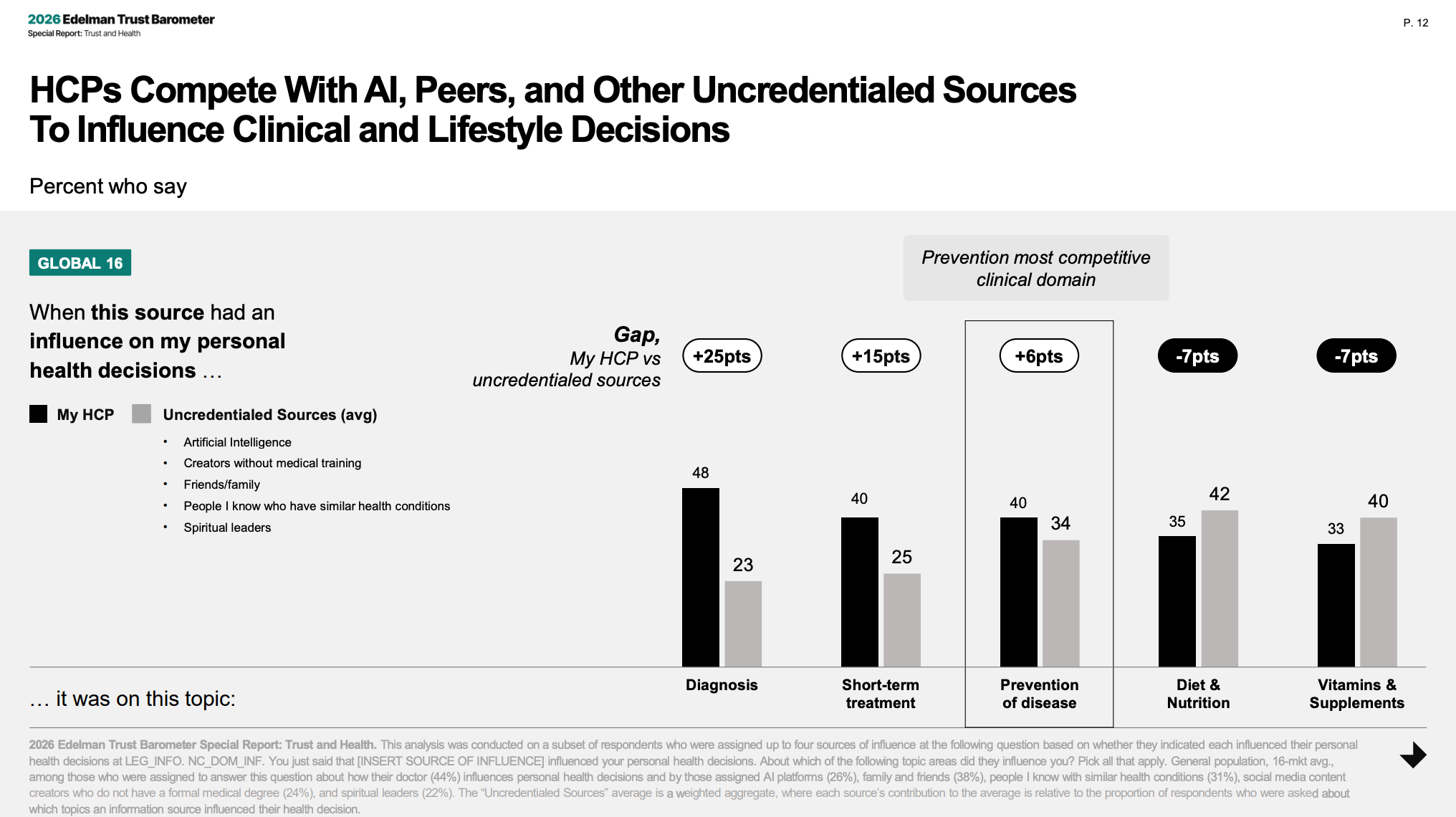
People trust medical expertise when they are sick, but preventive health issues are more contested.
If you’ve followed diet culture in media or the rise of the largely unregulated supplements industry, this probably makes intuitive sense to you. I mean, even established preventive health measures like vaccinations and fluoridation are hot topics again.
For health professionals and institutions, this suggests that preventive health is an especially critical area for proactive public engagement.
◾
Belief in contested health claims isn’t fringe. It’s the norm.
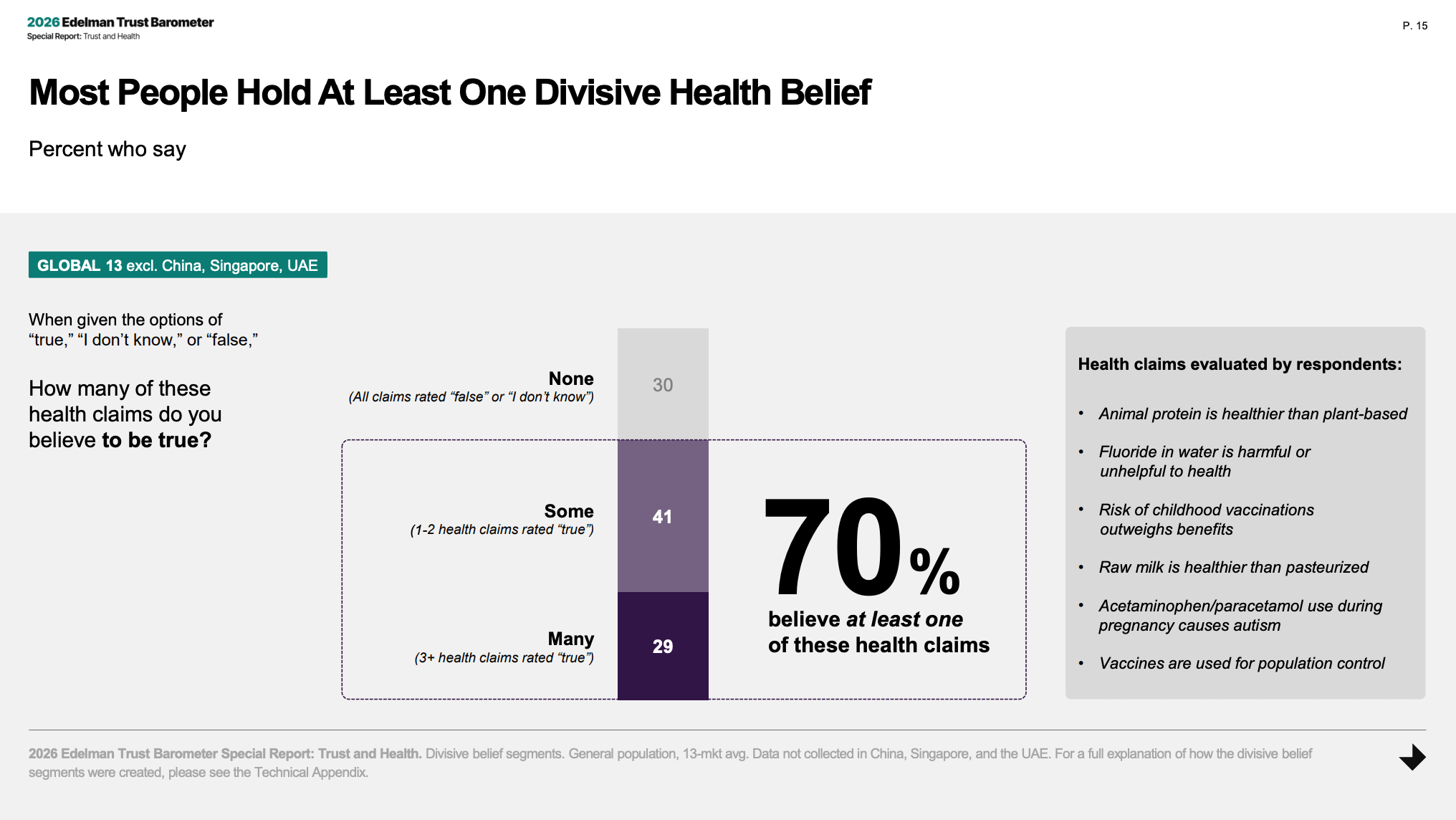
Edelman tested six “divisive” health claims among a representative sample of global respondents:
Animal protein is healthier than plant-based.
Fluoride in water is harmful or unhelpful to health.
Risk of childhood vaccinations outweighs benefits.
Raw milk is healthier than pasteurized.
Acetaminophen / paracetamol use during pregnancy causes autism.
Vaccines are used for population control.
You’ve probably heard at least one of these claims – perhaps online, from family, or even from government leaders. You may have scoffed at or dismissed people who believe fringe theories like these.
But Edelman’s research shows that 70% of respondents believe at least one of the claims.
That’s not fringe.
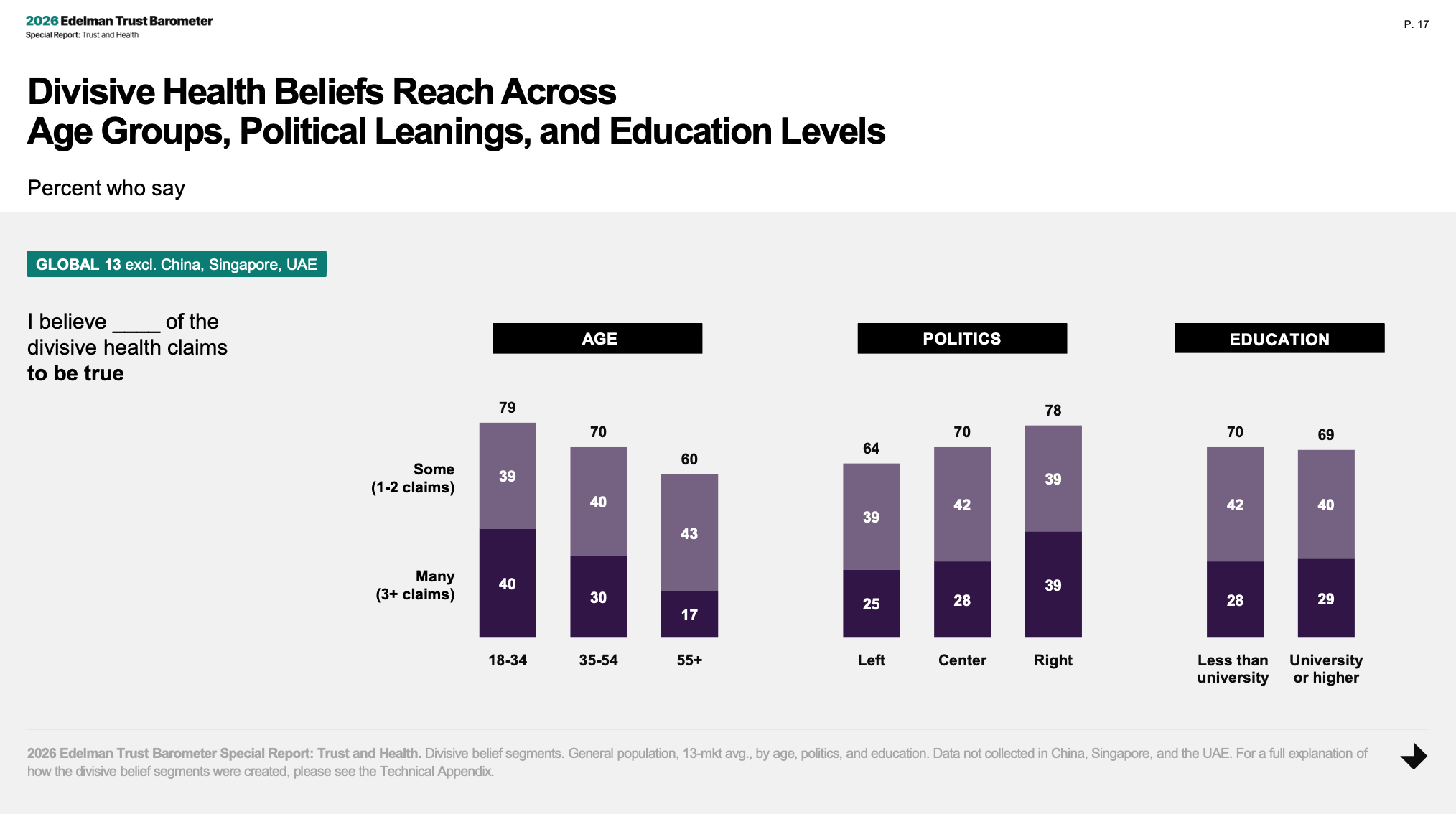
It’s not about education, either. Having a university or post-graduate degree plays practically no role in a person’s likelihood of believing contested health claims.
◾
People with divisive health beliefs consume many different kinds of health information.
Edelman found that people who hold more divisive health beliefs are more likely to consult multiple kinds of sources than their peers.
This finding is the most striking to me. As a media literacy advocate, I regularly encourage people to consult multiple materials to check a source’s credibility, verify its claims, and build a fuller understanding of complex topics.
But on its own, emphasizing “more” may actually be overly simplistic. Just because you consult “more” sources doesn’t mean you are equipped to evaluate their credibility. In fact, Edelman’s findings challenge the assumption that “doing more research” necessarily leads to being better informed about health.
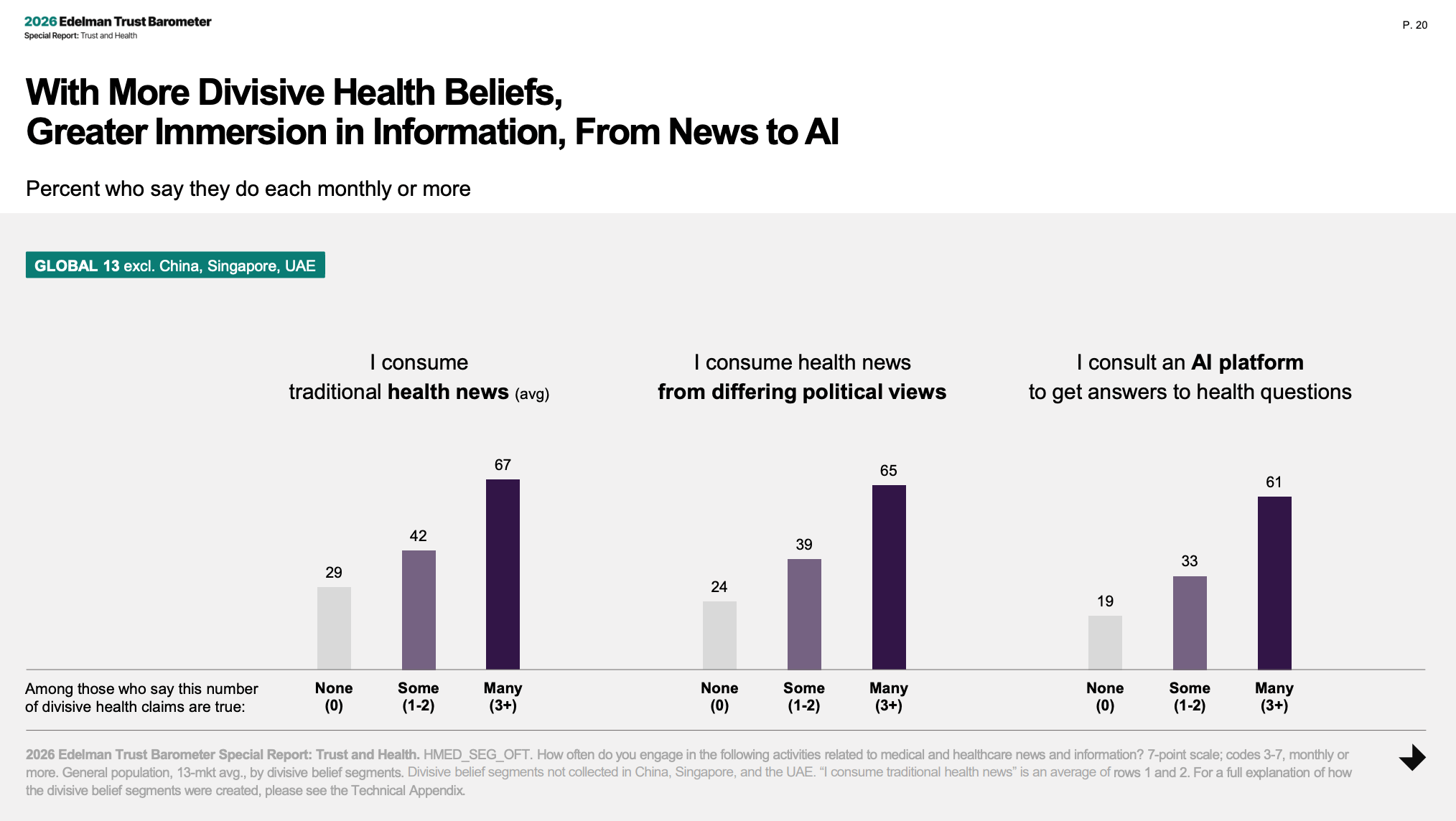
And as people consult different spaces for health information, it’s more important than ever for experts to be present in them. Unlike traditional one-way broadcast models, today’s media landscape is inherently about “more.” More voices. More opinions. More exchange. More back-and-forth.
So who can help cut through the noise?
◾
Medical professionals are the most trusted messengers – even among people with divisive health beliefs.
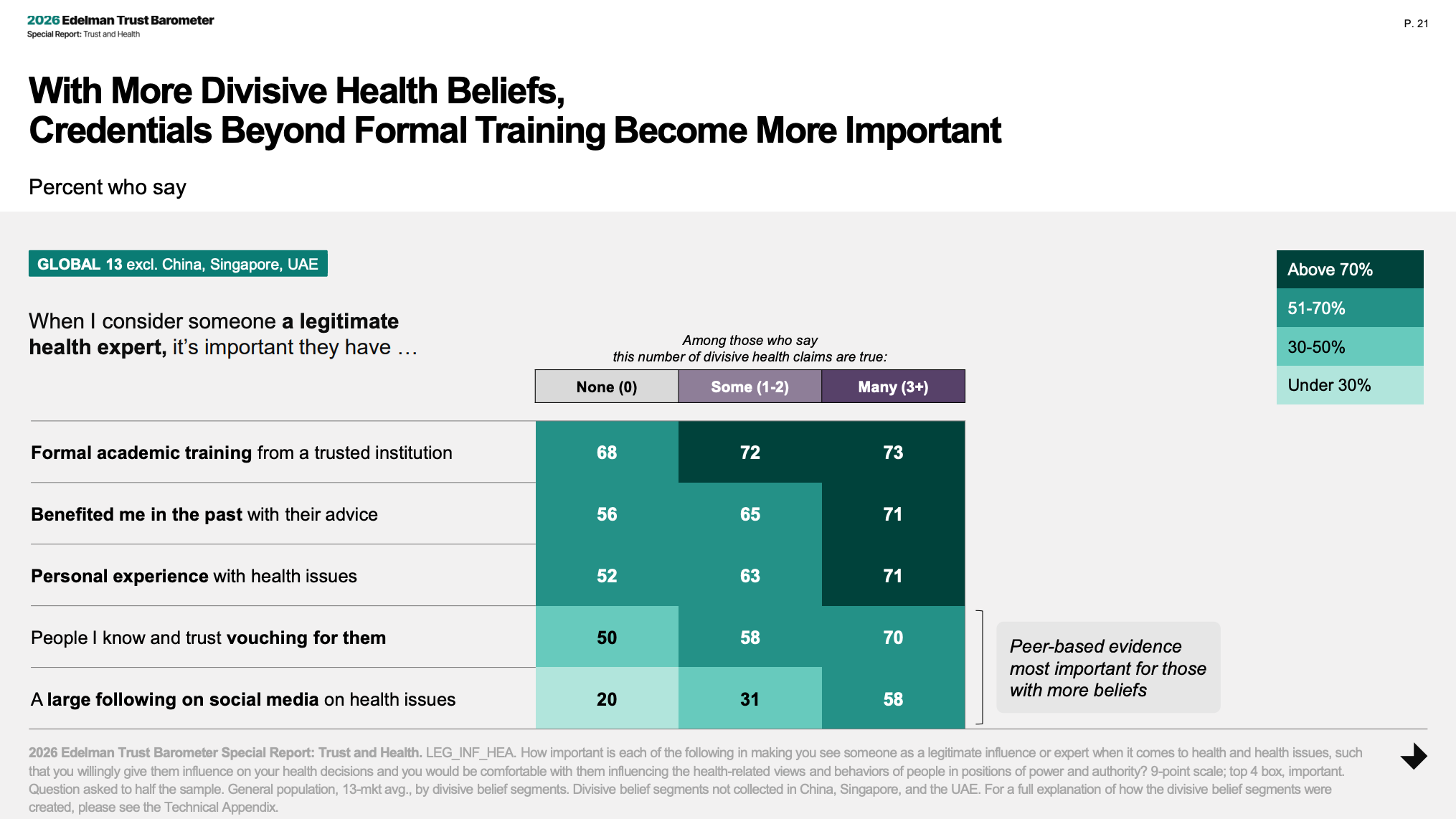
Here’s what is encouraging from Edelman’s research. Even among people who hold multiple divisive health beliefs, doctors and medical scientists remain among their most trusted sources of health information.
In fact, people who believe more contested health claims actually value formal academic training more than those who believe fewer contested health claims. In other words, they’re not necessarily driven by a distrust in the medical establishment. But they do value other credibility markers as well – like their familiarity with a specific messenger, or the messenger’s lived experience.
◾
Taken together, these findings give me hope. They suggest that medical professionals have an enormous opportunity. And medical expertise remains valued, including among people who hold contested health beliefs.
But we can’t assume things will stay that way. And if there’s anything we’ve learned about the information ecosystem, it’s that things change quickly. Faster than many institutions tend to adapt.
Considering what we know about how digital platforms shape people’s health beliefs, we need to examine whether we’re doing enough to prepare medical professionals to navigate these information environments.
National figures on digital literacy training in US medical schools are difficult to find. One 2022 study found that just 6% of surveyed medical students felt comfortable engaging with social media professionally. And in Germany (where I live), only 3.5% of public health programs offer any digital training modules.
I meet many health experts who are engaged in these issues in their personal capacity — as humans who went into medicine or healthcare to help people. I know that there are many physicians, nurses, and other health experts who genuinely want to meet people where they are online.
But we’re kidding ourselves if the strategy is to rely on individual physicians and nurses to film themselves quietly on breaks.
◾
Public digital engagement is real work. And if we want to make it sustainable and effective at scale, health institutions need to recognize it as more than a risk to be managed. It’s also an opportunity to support and a professional contribution to incentivize.
In practice, risk management, governance, and support structures will look different for each organization. But every workplace needs a sound social media policy, digital literacy training, and incentives to help their staff participate effectively and safely online.
Because the goal isn’t simply to put more doctors and nurses on social media. It’s to make medical expertise more useful in the environments where people make health decisions. ◾