

This year, I’ve become a full-blown content creator after fifteen years of a dogged, unabashed commitment to lurking.
I loved my life as a lurker. But at some point, the irony became too much. I’d built a career at Meta helping scientists, public health experts, government workers, and humanitarians run public information campaigns on Facebook and Instagram. I understood deeply why expert participation online was necessary to improve information quality and equity. And yet, I was scared to post anything under my own name.
Since leaving Meta in 2024, I’ve slowly but surely gotten more comfortable with putting myself out there. When you’re advocating for people to participate more actively online, you kind of need to create content yourself – both to raise awareness for the cause and to avoid being a hypocrite.
In January, I committed to writing regularly, and I’m proud to say that my Substack has become a place that feels truly mine. I love writing, always have. In my corporate life, I wrote a lot – op-eds, letters, and talks – under the names of better-known executives. It’s been freeing to explore my own voice, and I appreciate every single one of you who’s been reading along.
Mid-year, I started a podcast, Did You See?, with my friend and colleague, Michelle Ciulla Lipkin. Like many wonderful things in life, this happened organically with very little forethought. Michelle and I often found ourselves discussing the “hot” media moments of the day, and decided to try recording our conversations to model what media literacy looks like in action. From a content perspective, I’ve found audio to be a much more accessible format than long-form essays, and collaborating with a partner I trust allows me to show a different, dare I say more personable side of myself than my writing.
But the big kahuna – short-form video – was always my biggest fear.
◾
I’d dabbled in posting TikToks before, but only for fun. I talked about my personal hobbies, like wine and pop culture. Sometimes even combining the two: Adele is a Merlot; Tom Hanks is a Pinot Grigio kind of thing.
Last month, I committed to posting seriously on TikTok and Instagram for six months to see what would happen. My goal is to post at least five times per week, and I’ve been doing it now for four weeks.
Admittedly, part of my motivation was selfish. I wanted to reach more people, and TikTok and Instagram offer better discoverability than newsletters and podcasts, which need promotion themselves. But content creation is hard work, and talking on camera doesn’t come naturally to me. I knew I needed help to stay accountable, and am so grateful to have found Chicago-based social media extraordinaire and American history enthusiast, Catherine McDevitt (via Tracy Samantha Schmidt, also brilliant). With her expertise and support, I’ve gotten more comfortable with filming myself and turning all the ideas in my head into video series.
◾
Here’s what I’ve learned so far:
1. Even a “poorly performing” video has incredible reach.
Any new creator has spent time in TikTok’s dreaded “200-view jail.” The idea is that TikTok initially sends new videos to a small audience, then decides whether to show it to more people based on how the initial group engages. If engagement is low, your video might stall at around 200 views.
That can feel disappointing, but am I alone in thinking that even reaching 200 people is an amazing outcome? How often do you stand on a stage in front of 200 people? If I stick with my 5 videos per week goal, then in the worst case scenario, my ideas will be seen 1,000 times each week. That feels like a lot to me.

2. Words matter more than continuity.
Video is the most unforgiving format. If I notice an error after publishing an essay, or realize there’s a better way to phrase something, I can quietly edit it. Even with the podcast, I have safety in knowing it’s possible to re-record a line if absolutely necessary.
But video is harder to fix. Every take can have slightly different lighting, hair, clothes, or sound. I’ve filmed videos that seemed great at the moment, only to catch a small wording error while editing. At that point, you have two choices: reshoot the whole thing or accept that the final video might look off. I’ve done both, but when time is tight, I prioritize getting my words right over looking seamless.
3. Back camera for the win.
Maybe you’re not as vain as me, but on video calls I catch myself looking at my own image more than I care to admit. So talking to myself on my phone screen, which is already awkward enough as it is, is very hard to get through. I distract myself constantly, and not in a good way.
Now, I position my phone’s back camera to face me, with the tripod positioned in front of my laptop. That way, I can check that I’m in-frame without constantly noticing my flyaway hairs and weird facial expressions.
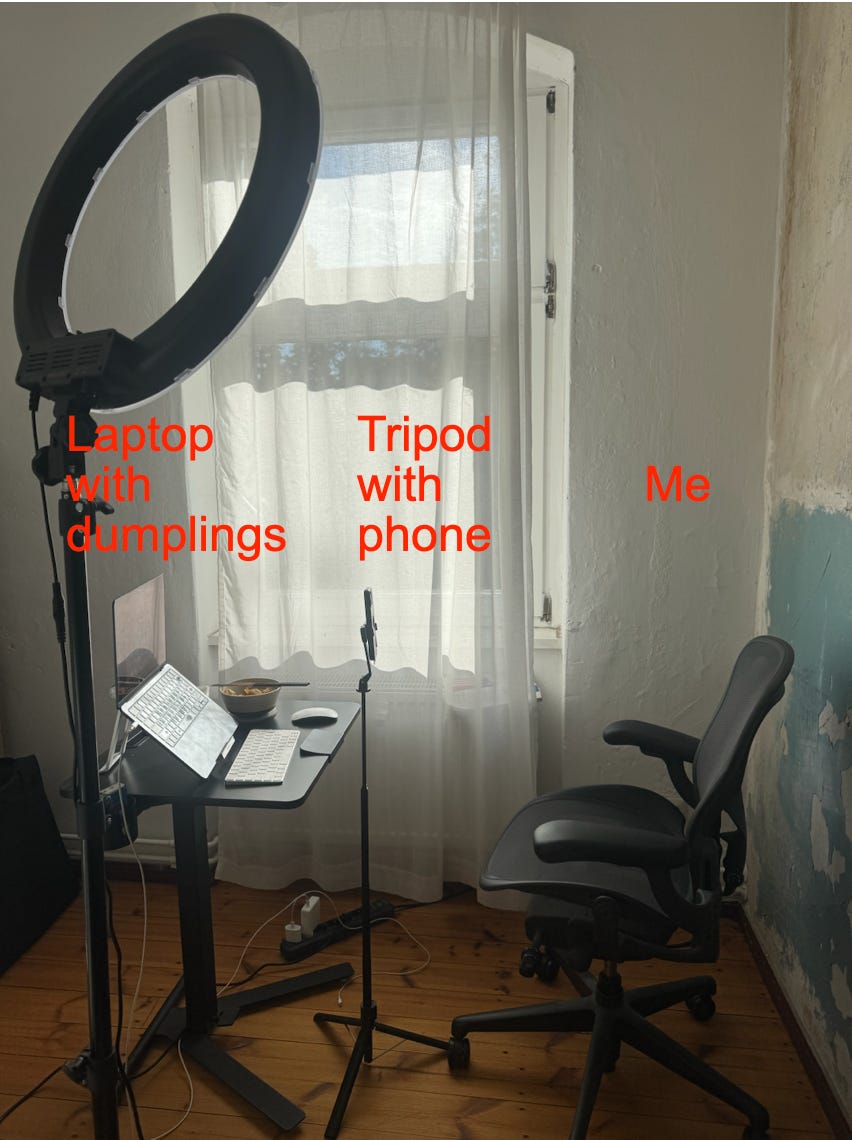
This has helped me to relax, feel less self-conscious, and speak more naturally. As they say, it’s best to speak on camera like you’re FaceTiming with a friend. And that feels a lot easier when I’m not staring at my big old head the whole time.
4. Consider your privacy preferences before you start posting.
This is embarrassing to admit, but I hadn’t fully appreciated how interconnected our apps can be, especially when they’re owned by the same company. Features designed to make it easier to find your friends also make it harder to control who discovers you. Your visibility doesn’t depend just on your own choices.
I thought I was being super private by never syncing my phone contacts to Instagram. But then I realized that my account could still be recommended to people who had saved my phone number and synced their contacts to Meta.
It’s been a pleasant surprise reconnecting with old friends and colleagues who have suddenly discovered me in their feeds. I can also understand why someone might have reservations about being recommended to people from their past, without their knowledge.
I wish platforms were more transparent about this and made it easier to control how your own information is used. If you’d like to check if your phone number or email address has been uploaded to Meta by someone else, you can do so here and also request to have your information removed and blocked.
5. Comments are a form of research.
When I speak with experts about creating content, one of the most common fears I hear is about comments. What if people disagree with what you said? What if they’re mean?
I’ve received some thoughtful comments, some that are less so, and a few that I don’t even understand. I’ve chosen to pay attention to the genuine questions and well-intentioned pushback, and ignore the rest.
Through that lens, comments have become one of the most interesting parts of posting. I’m learning what resonates with people, what they retain from my videos, where there’s room to dig deeper, and what people outside my usual circles think about trust and expertise online.
It’s also a good reminder that posting on digital platforms is inherently different from one-way broadcasting. This is about exchange, which can be scary. I choose to view it as research and an opportunity to learn from people I wouldn’t otherwise encounter.
◾
It’s funny. In many ways, I consider myself an expert on the digital information ecosystem, and yet there’s still so much I don’t know about what it’s like to participate in it. I suppose that’s true of any field: the more you learn, the more you realize how much you don’t know.
One month in, I have good days and bad days. Sometimes I feel energized and productive; other times I wonder what the heck I’m doing with myself. But that’s what I signed up for: six months of trying, experimenting, and being open to what happens. I’ll let you know what I learn. ◾