

Social media is a mirror and amplifier — not an inventor — of our values. And few cultural battlegrounds today are as charged as those over family and gender roles.
This week, I’m looking at how the conversation about gender has evolved since the end of the pandemic. From tradwives to worker burnout to the manosphere, creators have tapped into something deeper than nostalgia and set the stage for the current state of gender politics and discourse in the United States.
Tradwives and the virtues of traditional femininity
A tradwife, for anyone unfamiliar with the term, is a woman who espouses and glorifies traditional gender roles in her marriage and home (often with a subtext of a certain view of Christianity). While relying on her husband to pay the bills and support the family ‘in strength and defense,’ the tradwife’s domain is maintaining the household with a sense of nostalgia for the old days. For example, a tradwife may prepare foods from scratch which most people only know from plastic containers, she may wrangle farm animals, but almost always, she births and raises children. (it should go without saying that while doing all of this, she looks immaculately put together and remarkably well-rested).
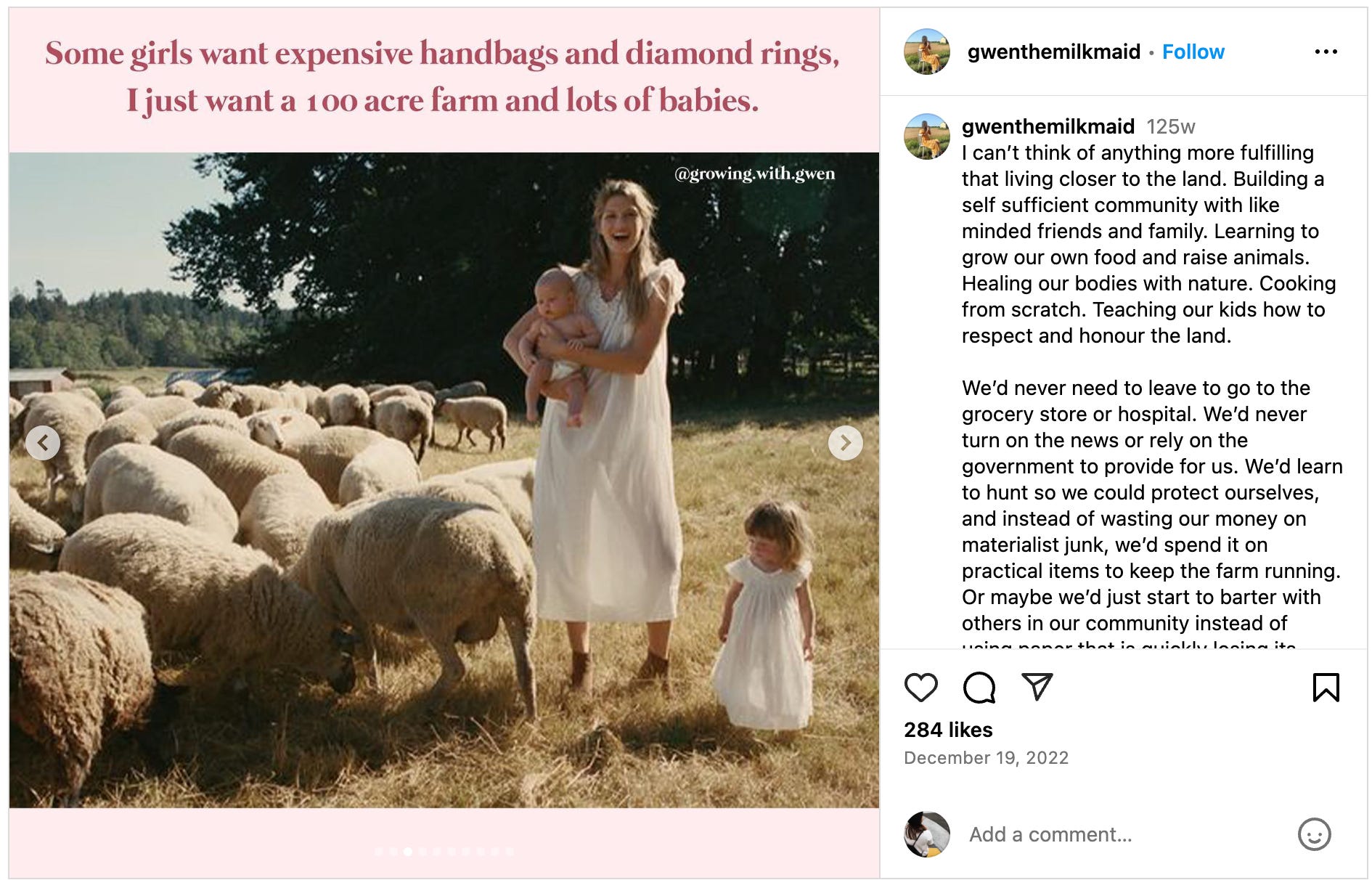
While the tradwife trend reached its peak last year, its roots sprouted around 2020/2021 — back when we were all stuck in our own homes, staring at walls needing overdue paint jobs, and living out our secret gardening and bread baking dreams. It was a perfect moment for tradwives, with their soothing aesthetic and homemaking skills, to tap into a zeitgeist and a mainstream audience that they otherwise may not have reached as effectively. And so, as things tend to go these days, they racked up views and followers, followed by lucrative partnership deals and revenue.
This dynamic was well summed up by the New York Times in 2024, when they ran two stories, ten months apart, about the same woman. The first one ran in February with the headline: “She gave birth two weeks ago. Now she’s in a beauty pageant.” By the end of the year, NYT was pondering if this woman is a “tycoon or tradwife.” The answer is yes.
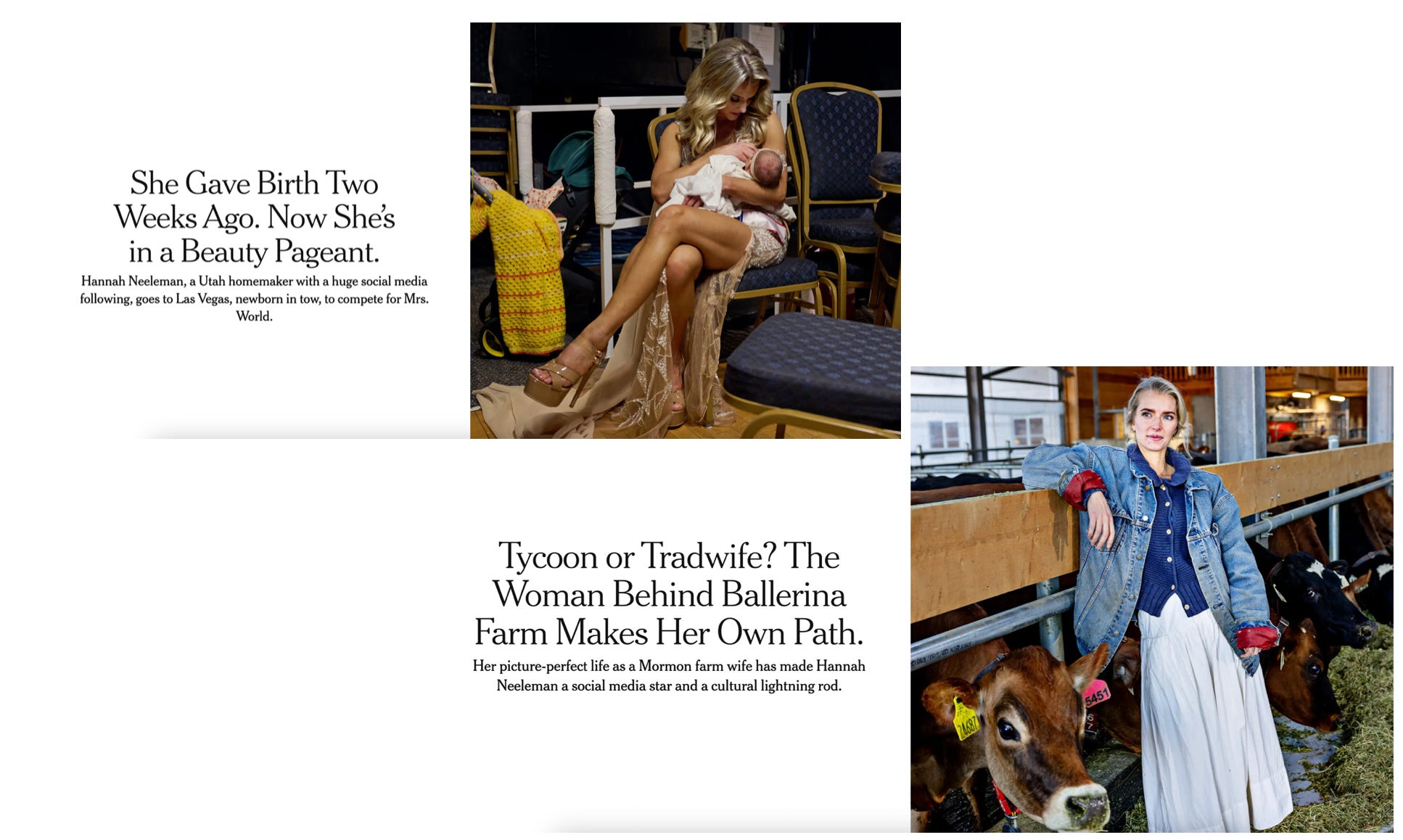
The beauty queen-mother-tycoon-tradwife in question is a woman named Hannah Neeleman, a former professional dancer, Mormon, daughter-in-law of the JetBlue founder, and one of today’s most recognizable tradwives. Interestingly, in the same year that NYT gave her two mostly positive profiles, Hannah found herself on the defensive after a critical Times of London piece questioned her authenticity (bless the Brits and their skepticism).
Another high-profile tradwife is Nara Smith, whose TikTok started to go viral towards the end of 2023. Like Hannah, Nara is married to a Mormon man and lives in Utah. Unlike Hannah, Nara is not American; she grew up in Germany with a Black South African mother and a White German father. Nara fascinates people, I surmise, because we’re not used to seeing non-White non-Americans espouse such traditional American living. I also find that her videos – in which she often cooks dinner while dressed like she’s heading to the Oscars – are laced with a cheekiness that feels like she’s letting us in on a joke. But whether it’s us she’s trolling or the general tradwife performance, is unclear.
While being an online tradwife can be big business (perhaps multiple oxymorons here), it’s important to distinguish them from other homemakers who have won at capitalism, like hosting queens Ina Garten and Martha Stewart, and even from celebrity lifestyle influencers like Gwyneth Paltrow and Meghan Sussex. What makes tradwives unique is the identity and politics behind their content. As cozy and idyllic as it looks, this is not about the joy of cooking. Rather, it’s about romanticizing a lifestyle that relegates a woman’s role to homemaking, child rearing, and ceding to her husband as the top dog.
Marriage might be a partnership, but ‘there will always be one top dog’ … The husband pays the bills and supports the family in ‘strength and defence,’ making him the head of the household. The wife supports his decisions, assuming they are made fairly … ‘It’s basically like trusting the Finance Manager to help run your business.’ – The Rise and Fall of the Tradwife, The New Yorker, March 2024
Whyyyy, we all wondered, were we so captivated by this content? A thousand think pieces, news articles, talk show segments, podcasts, university courses, and subreddits were launched to figure out why we were all so damn into tradwives. It’s perhaps most puzzling to those of us who identify as proud, progressive feminists. After decades of fighting for our careers and financial independence, even we can’t scroll past a video of a woman spending hours making bread, peanut butter, and jelly from scratch for her seemingly very patient kids.

 Tiktok failed to load.
Enable 3rd party cookies or use another browser
Institutions were failing workers (especially women)
In a world where women bear disproportionate responsibilities with less rewards, there can be something aspirational, even to career-driven women, about having the comfort, time, security, and resources to be able to forgo it all. How amazing it could be to rely on an imaginary perfect person to take on all the emotional labor of making (correct) decisions for our best interest. Indeed no one has seen a tradwife stress over the price of eggs for her perpetually-stocked kitchen.
That’s why I don’t think it’s a coincidence that the timing of #tradwives coincided with worker rights trends like the Great Resignation (2021) and #quietquitting (2022). Coming out of the pandemic, corporate hustle culture was exhausting already-drained people and leading to burnout. Moreover, these movements recognized how badly our systems and institutions were failing the majority of people, and affecting women more than men.
It was only natural for people to let it out online and take back what control they could. Overachieving for your boss was out; doing the bare minimum was in. We took joy in escapism and fantasy. Who hasn’t dreamt at least once in the last five years of bucking it all and starting a farm for a ‘simpler’ life?
 Tiktok failed to load.
Enable 3rd party cookies or use another browser
The manosphere got legit
If tradwives offered one type of fantasy to a disenfranchised public (e.g. comfort, submission, domestic beauty), then the manosphere offered another (e.g. control, dominance, defiance).
And so, while some of us were watching the rise of tradwives, others were enjoying a formidable male counterpart, which had reached a new milestone of legitimacy. In 2020, The Joe Rogan Experience, a conspiracy theory-friendly podcast which had already been thriving on YouTube and Sirius XM, went truly mainstream in an exclusive $100M deal with Spotify. Joe, along with other ‘manosphere’ creators who believe that feminism is harmful to society, have successfully tapped into and mobilized disaffected young men across the country who are honestly struggling. And while manosphere and tradwife creators are delivering it in different ways, the core of their message is the same: things were better when gender roles were simpler.
Proof is in the numbers. Over the last five years, Hannah’s Instagram account has grown 50X from 200k to 10M, and Joe’s doubled from 9.5M followers to nearly 20M (and he has consistently been Spotify’s most-listened-to podcast for years) . In other words, by the time progressives were balking at JD Vance’s much-memed ‘childless cat ladies’ remarks in the summer of 2024, the reality is that this kind of discourse had already been normalized for the masses.
People started to feel comfortable embracing their inner-MAGA
I don’t believe that creators like Hannah, Nara, or other tradwives started making content because they necessarily wanted to influence politics. But nevertheless, their story is just as much about information as it is about culture. Their content resonated with people because it tapped into a feeling that had already been brewing within a lot of Americans across the political spectrum. And by popularizing a nostalgia for a past that never existed, they helped to embolden more extreme messaging about gender and the Trump administration’s ensuing onslaught of harmful policies that have reduced women’s reproductive rights, freedom of movement, and economic opportunity.
Where are we now?
We live in a time warp these days, both online and in ‘real life.’ In the five months since President Trump’s inauguration, we’re seeing more direct discussion online on both sides, from the pronatalist movement to the #childfreebychoice trend. Next time, we’ll talk about how people online are getting more personal than ever about the realities of parenthood and the difficult decisions women face about becoming a mother.
Scrolling through
It’s hard to imagine a time when abortion was not a lightning rod topic — but it wasn’t until the 1990s. This vintage episode of The Daily revisits how Newt Gringrich and the Republican party recognized and positioned abortion as a critical wedge issue that could put Democrats on the back foot.
There’s been controversy in Australia between two baking creators over alleged recipe plagiarism. It’s raising some interesting perspectives on imitation vs inspiration in a world where small business owners pretty much have to self-promote online.
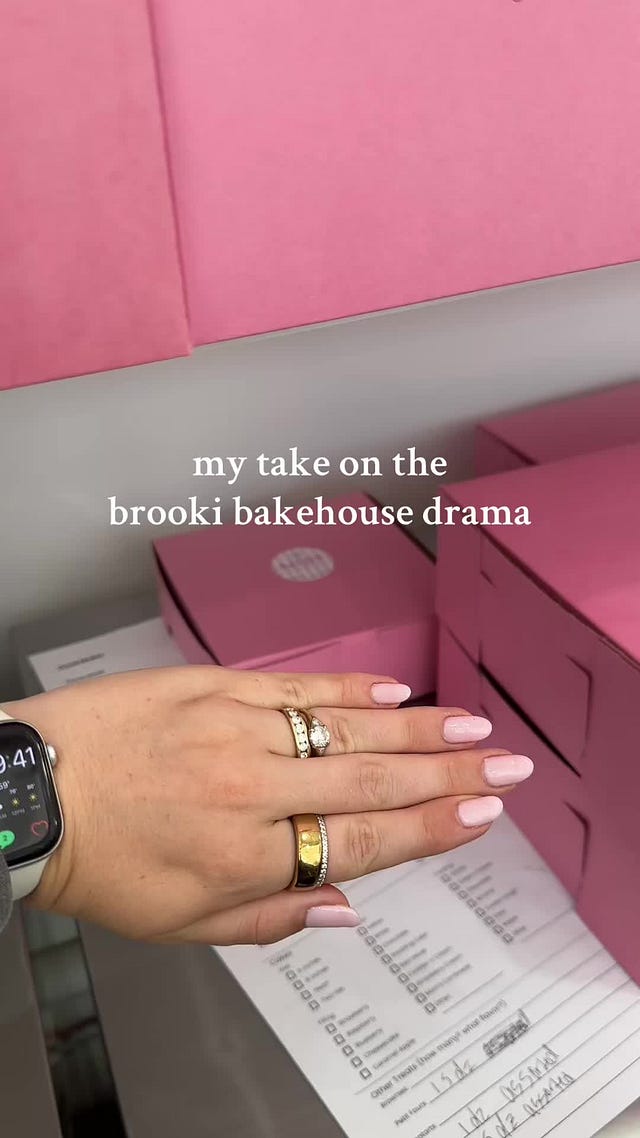 @abicaswellsome big news the past few days in the baking world 🥲 it seems like there’s always some type of #cakegate drama going on!!! recipes are so incredibly hard to protect, as well as intellectual property and content. what can be done?? this is just such a sad situation all around. you never want to see someone fail, or in the trenches with people trying to cancel them, but how do you defend it even if it is “just a caramel slice.” It’s the recipe makers heart and mind. Again, it’s just sad all the way around. We may never really know, but of course perception is everything. #brookibakehouse #brooki #bakeryowner #SmallBusiness #recipes #fyp #dayinthelife #workwithme #foryou #CapCutTiktok failed to load.
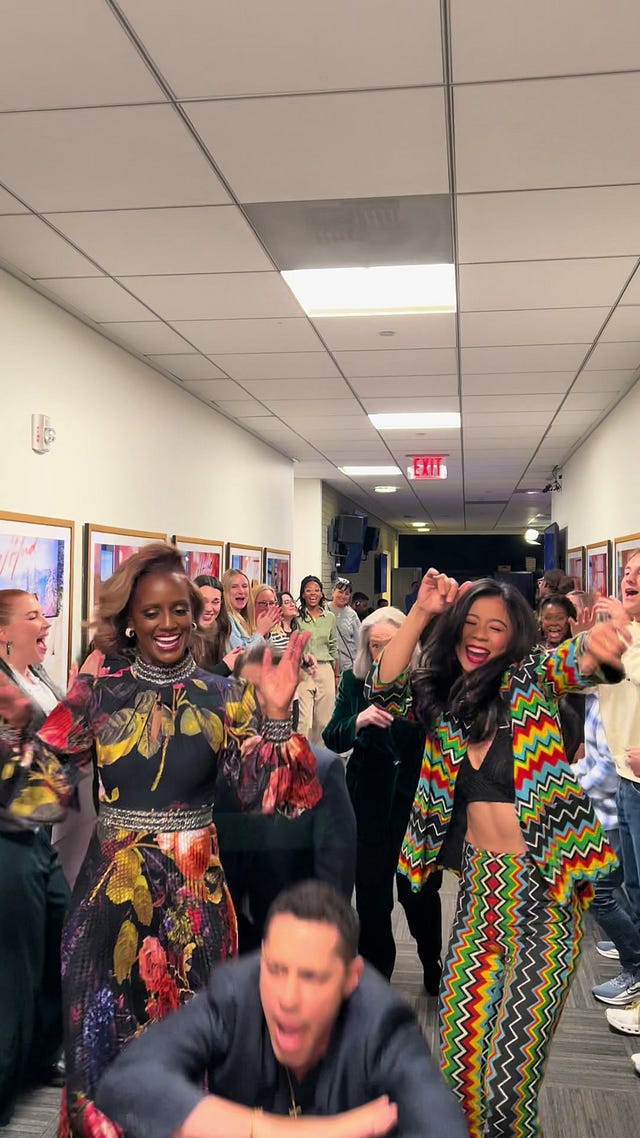
Enable 3rd party cookies or use another browserPop Culture Happy Hour analyzed the viral spirit tunnel videos from The Jennifer Hudson Show. They are super fun to watch, but hats off to Kathy Bates for channeling how I imagine I would react in the same circumstance. #introvertsunite
 Tiktok failed to load.
Enable 3rd party cookies or use another browser
Happy place
In honor of US Mothers Day this month, meet Mika and her mom who love to look at handsome celebrities together. Wishing all moms, daughters, and mother-figures similar laughter and fun with your loved ones, whatever your choice of shared hobby may be :-)
 Tiktok failed to load.
Enable 3rd party cookies or use another browser